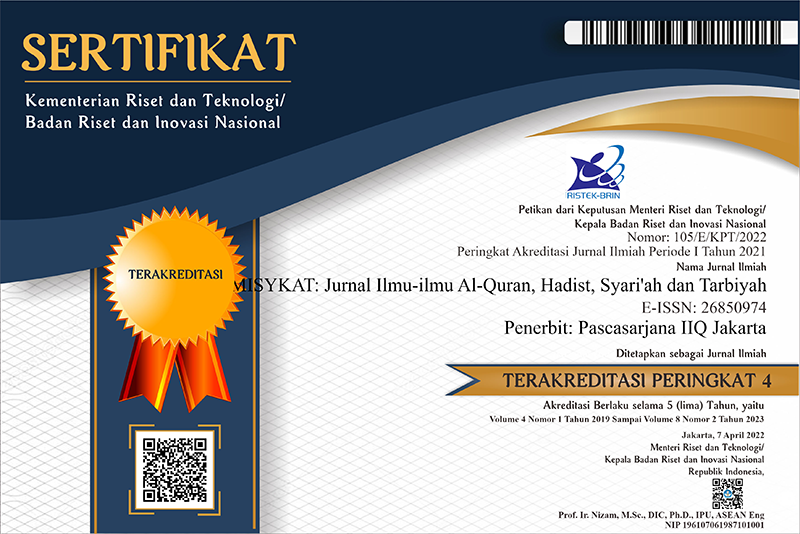
Moderasi Beragama Dalam Perspektif Sa’id Hawwa’ Dan Implementasinya Terhadap Nilai Humanisme (Kajian Kitab al-Asas Fi al-Tafsir)
Abstract
Religious moderation means practicing religion by choosing the middle path, in the sense of not being radical, not extreme, not rigid, and not excessive in dealing with differences in groups that are not the same as ourselves. It also means not being overly excessive in practicing religious teachings to the point of neglecting the surrounding world and disregarding others. Respecting fellow human beings is also embodied in Pancasila, which states "just and civilized humanity," meaning we must respect fellow human beings regardless of race, ethnicity, group, social status, or even religion. In this study, the researcher will discuss the interpretation of religious moderation from the perspective of Sa'id Hawwa' and how the interpretation of moderation is implemented towards humanistic values. The type of research used in this study is library research. In the exploration of verses, the researcher uses a conceptual thematic approach, while the approach used in the interpretation is the thematic figure. The data sources used in this study consist of primary and secondary data. The techniques used in data analysis are descriptive and analytical methods. The results of the research on religious moderation from Sa'id Hawwa's perspective are that Islam has offered the value of moderation to humans. The purpose of this moderation is none other than to unite and respect differences, achieve peace, apply justice in all actions, promote good and prevent evil, and obey the government regardless of race, ethnicity, or even religion. The implementation of the interpretation of moderation verses towards humanistic values is to realize universal human values and teach the protection of human rights for all individuals, regardless of race, ethnicity, group, social status, or even religion. This includes the responsibility to ensure the welfare of all people.References
Muslim, Abi Al-Husain Ibn Hajjaj Al-Qusyairi An-Naisaiburi. sahih muslim. Kairo: Dar al
Kutub, 1918.
‘Aqi l (al), Al-Mustashar Abdulla h. Mereka yang telah Pergi; Tokoh–tokoh Pembangun
Pergerakan Islam Kontemporer. Jakarta: Al-I‘tisham Cahaya Umat. 2003.
Abdullah, Rachmad. Walisongo Gelora Dakwah dan Jihad di Tanah Jawa. Surakarta :Al-Wafi,
2015.
Amrullah, Abdul Malik Abdul Karim (Hamka). Tafsir Al-Azhar. Singapura: Pustaka Nasional
Pte Ltd, t.t.
As faha ni (al), Al-Raghi b. Mufrada t al-Fa d ul al-Qur’a n. Beirut: Da r al-Qalam. 2009.
Bukhara , Abu Abdilla h Muhammad Bin Isma il. S ohi h Bukhori . Bairut: Da r Ibn Kathi
r. 2002.
D ayf, Shawqi . al-Mu'jam al-Wasit . Mesir: Maktabah Shuru q al-Dawliyyah, Cet. Ke-4, 2004
Fadlullah. Khazanah Peradaban Islam Nusantara. Serang Banten; Tiara Kerta Jaya, 2016.
Gesmi, Irwan dan Yun Hendri. Pendidikan pancasila. Uwais Inspirasi Indonesia, 2018.
Hanafi Imam dkk. Kecenderungan aktivis mahasiswa PTKIN se-Jawa Tengah Antara
Radikal, Moderat, Liberal. Pekalongan : PT Nasya Expanding Management, 2023.
Hanafi, Muchlis M. dkk. Moderasi Beragama. Jakarta: Lajnah Pentashihan Mushaf Al-Qur’an.
2022.
______, Asba b al-Nuzu l: Kronologi dan Sebab Turun Wahyu Al-Qur’an. Jakarta: Lajnah
Pentashihan Mushaf Al-Qur’an Badan Litbang dan Diklat Kementerian Agama RI,
2017.
Hardyanto. “Moderasi”, Majalah Tempo. 5 Januari. 2009.
Hasbullah, Mushaddad Dan Mohd Asri Abdullah. Wasatiyyah Pemacu Peradaban Negara.
Negeri Sembilan: Institut Wasatiyyah Malaysia. 2013.
Hawwa ’, Sa’i d. al-Asa s fi al-Tafsi r. Kairo: Da r al-Sala m. 1985.
______, Ha dhihi Tajarrubati Wa Ha dhihi Shaha dati . Kairo: Da r Al-Taufi q Al
Namudhajiyyah, 1987.
Ibn Ashu r. Al-Tah ri r Wa Al-Tanwi r. Tunis: Al-Da r Tunisiyyah. 1984.
Ibn Hanbal, Ah mad. al-Musnad. Beirut: Mu'assasah al-Risa lah, 2001.
Ibn Kathi r, Abu al-Fida ’ Isma’i l Ibn ‘Umar al-Quraishi. Tafsi r al-Qur'a n al-Azhim. Riyad:
Da r al-T aybah.1999.
Ismail, Faisal. Paradigma Kebudayaan Islam: Studi Kritis dan Refleksi Historis. Yogyakarta:
Titian Ilahi Press, 1997.
Itzchak, Weismann. “Sa’i d Hawwa ’ And Islamic Revivalism In Ba’thist Syria” dalam Studia
Islamica, No. 85, 1997.
______, “Sa’i d Hawwa ’-The Making Of A Radikal Muslim Thinker In Modern Syria”,
dalam Middle Eastern Studies, Vol. 29, No. 4, Oktober, 1993.
Kahmad, Dadang. Sosiologi Agama. Bandung: PT Remaja Rosdakarya: 2002.
Kementerian Agama Republik Indonesia. Al-Qur'an Dan Tafsirnya. Jakarta: Widya Cahaya,
2011.
Kementrian Agama Republik Indonesia. Al-Qur’an Dan Terjemahannya Edisi
Penyempurnaan. Jakarta : Lajnah Pentashihan Al-Qur’an. 2019.
Mara ghi (al), Ah mad Must afa . Tafsi r al-Maraghi. Beirut : Da r al-Fikr, 1974.
Munir, Abdullah Dkk, Literasi Moderasi Beragama Di Indonesia. Bengkulu: Zigie Utama,
2019.
Muslim, Bukhori. Nilai-Nilai Moderasi Beragama. Aceh: Bandar Publishing. 2002.
Muthahhari, Murtadha. ‘Amar Makruf Nahyi Munkar, Terj. Salman Fadlullah. Jakarta: Al
Huda, 2006.
Nawa wi (al), al-Minha j Syarḥ Ṣaḥīḥ Muslim bin al-Ḥajjjaj. Kairo: al-Mis riyyah, 1929.
Qard a wi (Al) , Yusu f. Al-Isla m Hadarah Al-Gha d. Kairo: Maktabah Wahbah.1995.
_____, Al-Khas a is Al-Immah Li Al-Isla m. Beirut: Mu'assasah Al-Risa lah. 1983.
Qazwīni (al), Aḥmad Ibn Fāris. Mu‘Jam Maqāyīs al-Lughah. Bairut: Da r Al-Fikr, 1979.
Sha’ra wi (al), Muh mmad Mutawalli .Tafsi r al-Sha’ra wi. Kairo: Ikhba r al-yaum.
Shihab, M. Quraish. Menyingkap Tabir Ilahi. Jakarta: Lentera Hati, 2005.
_____, M. Quraish. Wasat iyyah Wawasan Islam Tentang Moderasi Beragama. Tangerang:
Lentera Hati, 2012.
Sugeng, “Pendidikan Rabbani Perspektif Sa’i d Hawwa ’ dalam Kitab Mudzakkirat Fi Mana
zili As -S iddiqi n Wa al-Rabbani yyi n min Khila li al-Nus us ” dalam Tesis,
Universitas Muhammadiyah Surabaya, 2020.
Thoha, Miftah. Birokrasi Pemerintahan Indonesia di era reformasi. Jakarta: Kencana.
Tim Penyusun Kementerian Agama RI. Moderasi Beragama. Jakarta: Badan Litbang Dan
Diklat Kementerian Agama RI. 2019.
Tim Penyusun. Kamus Bahasa Indonesia Pusat Bahasa. Jakarta: Pusat Bahasa. 2018.
Tim Penyusun. Pendidikan Pancasila. Yogyakarta: Total Media, 2009.
Zakiyah, Qiqi Yuliati dan H.A. Rusdiana. Pendidikan Nilai “ Kajian Teori dan Praktik di
Sekolah”. Bandung: Pustaka Setia, 2014.
Copyright Notice
Copyright and Licensing Terms of Jurnal MISYKAT
Authors who publish their work in Jurnal MISYKAT agree to the following terms:
-
Copyright Retention: Authors retain full copyright ownership of their articles without any restrictions.
-
Right of First Publication: Authors grant Jurnal MISYKAT the right of first publication, allowing the journal to publish and distribute the work simultaneously in both print and electronic formats.
-
Creative Commons Licensing: All articles published in Jurnal MISYKAT are licensed under a Creative Commons Attribution-ShareAlike 4.0 International License (CC BY-SA 4.0).
What does this mean for authors and readers? Under this license, anyone is free to:
Share: Copy and redistribute the material in any medium or format.
Adapt: Remix, transform, and build upon the material for any purpose, even commercially.
Under the following strict conditions:
Attribution: You must give appropriate credit, provide a link to the license, and indicate if changes were made. You may do so in any reasonable manner, but not in any way that suggests the licensor endorses you or your use.
ShareAlike: If you remix, transform, or build upon the material, you must distribute your contributions under the same license as the original.
-
Self-Archiving Policy: Authors are permitted and highly encouraged to post their work online (e.g., in institutional repositories, open-access repositories, or on their personal websites) after the official publication process is complete. This practice is encouraged as it can lead to productive academic exchanges, as well as earlier and greater citation of the published work.
Privacy Statement (Recommended addition for OJS)
The names and email addresses entered in this journal site will be used exclusively for the stated purposes of this journal and will not be made available for any other purpose or to any other party.