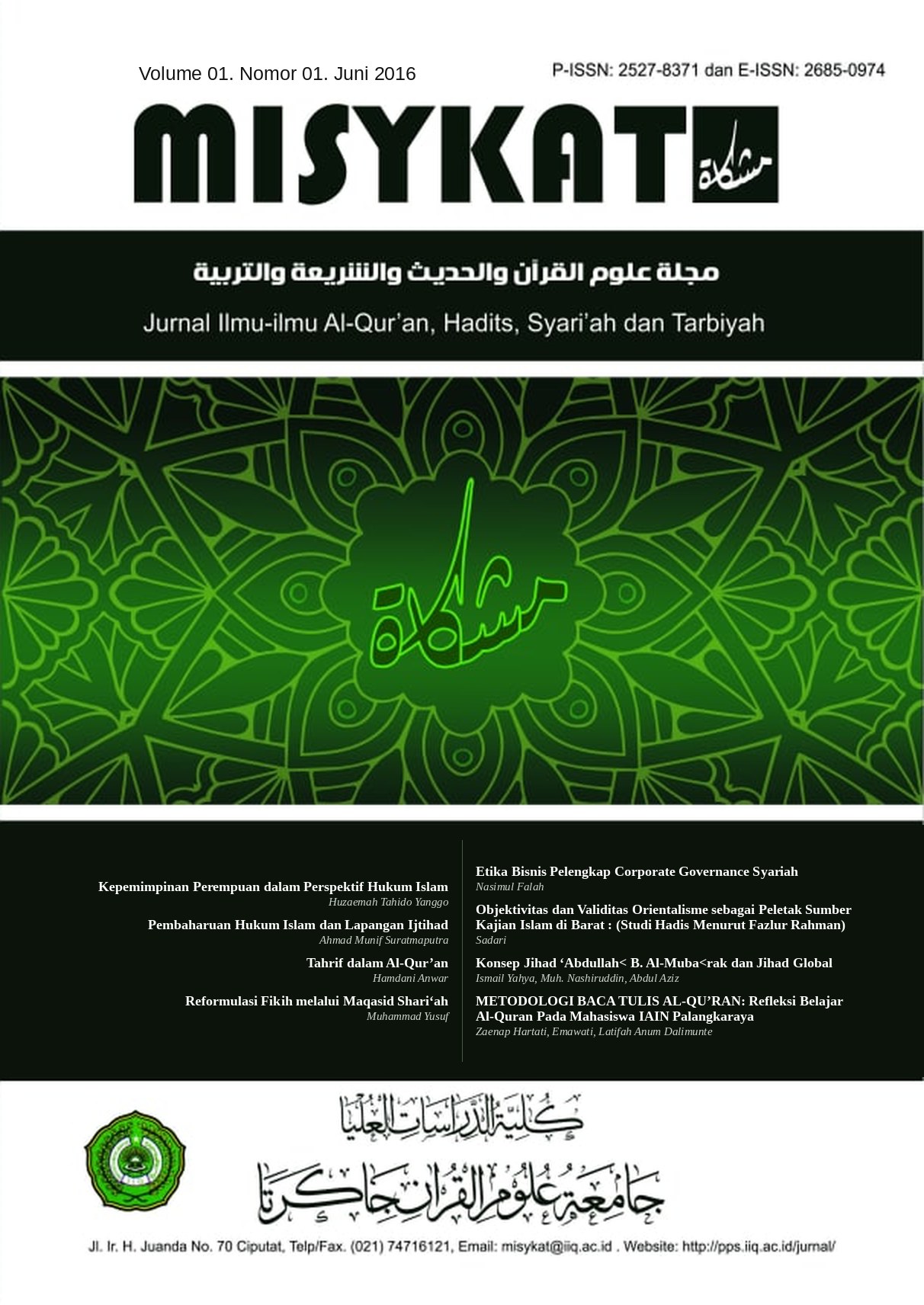
METODOLOGI BACA TULIS AL-QU’RAN: Refleksi Belajar Al-Quran Pada Mahasiswa IAIN Palangkaraya
Abstract
Both upon admission and during the practicum course Qur'an Reading Practice (PMQ), students of IAIN Palangka Raya take a Qur'an reading test, yet their reading ability is still not optimal, and some students have difficulty reading the Qur'an properly and correctly. This study aims to explore the problems students face before and during their learning process in order to find solutions to the problem of Qur'an reading ability among students of IAIN Palangka Raya. The research was conducted at IAIN Palangka Raya using a qualitative descriptive approach, with students as informants. Data were collected through interviews, observation and documentation. The study shows that the students first learned to read the Qur'an predominantly from their parents, then from other family members, and subsequently from Qur'an teachers or institutions. Regarding the use of their Qur'an reading competence, students who consistently read and study the Qur'an improve their recitation and are even able to teach others. The reflections drawn from learning the Qur'an include peace of mind, receiving guidance, and multiplied rewards from reciting the Qur'an.
References

This work is licensed under a Creative Commons Attribution-ShareAlike 4.0 International License.
Copyright Notice
Copyright and Licensing Terms of Jurnal MISYKAT
Authors who publish their work in Jurnal MISYKAT agree to the following terms:
-
Copyright Retention: Authors retain full copyright ownership of their articles without any restrictions.
-
Right of First Publication: Authors grant Jurnal MISYKAT the right of first publication, allowing the journal to publish and distribute the work simultaneously in both print and electronic formats.
-
Creative Commons Licensing: All articles published in Jurnal MISYKAT are licensed under a Creative Commons Attribution-ShareAlike 4.0 International License (CC BY-SA 4.0).
What does this mean for authors and readers? Under this license, anyone is free to:
Share: Copy and redistribute the material in any medium or format.
Adapt: Remix, transform, and build upon the material for any purpose, even commercially.
Under the following strict conditions:
Attribution: You must give appropriate credit, provide a link to the license, and indicate if changes were made. You may do so in any reasonable manner, but not in any way that suggests the licensor endorses you or your use.
ShareAlike: If you remix, transform, or build upon the material, you must distribute your contributions under the same license as the original.
-
Self-Archiving Policy: Authors are permitted and highly encouraged to post their work online (e.g., in institutional repositories, open-access repositories, or on their personal websites) after the official publication process is complete. This practice is encouraged as it can lead to productive academic exchanges, as well as earlier and greater citation of the published work.
Privacy Statement (Recommended addition for OJS)
The names and email addresses entered in this journal site will be used exclusively for the stated purposes of this journal and will not be made available for any other purpose or to any other party.