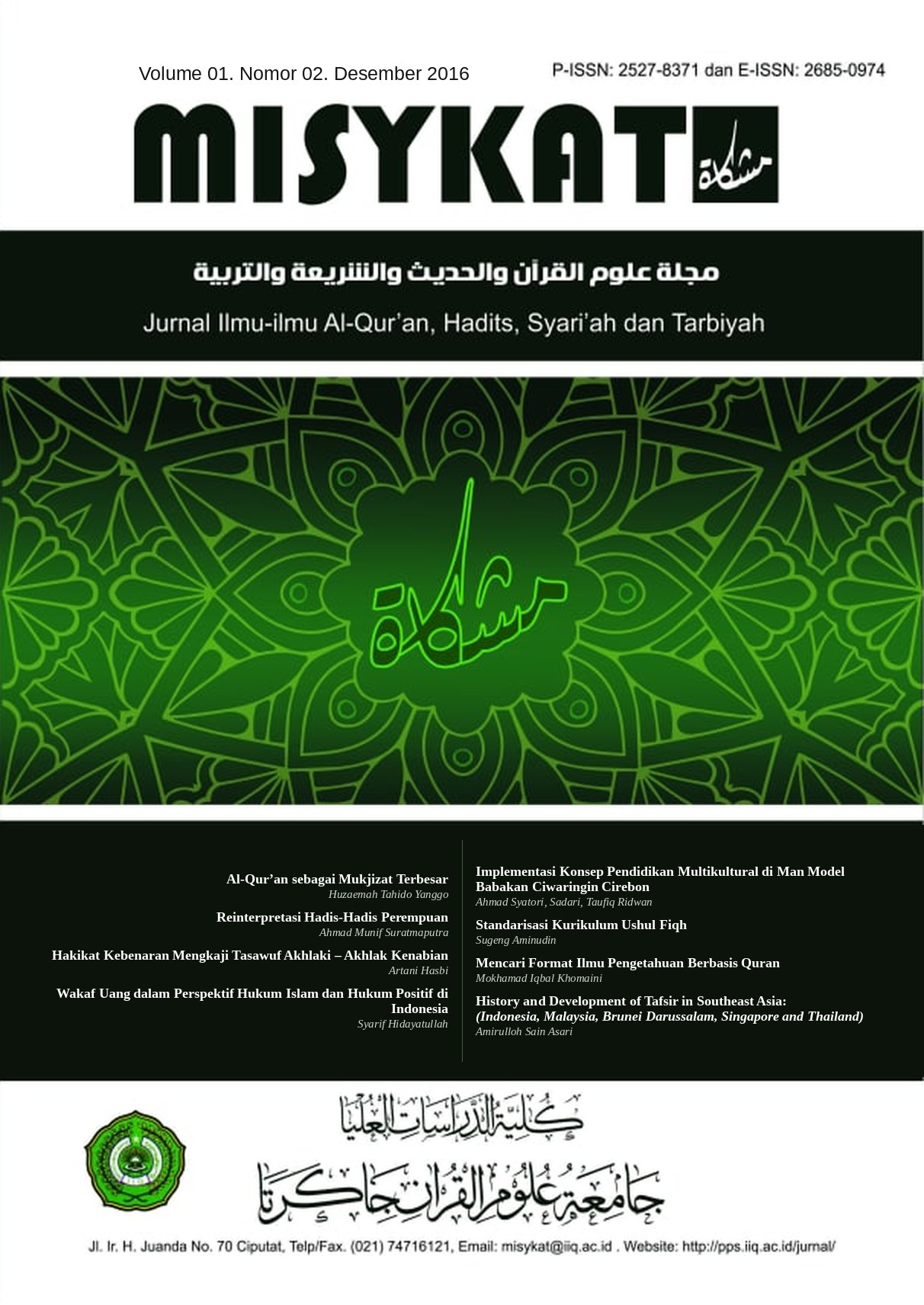
HAKIKAT KEBENARAN MENGKAJI TASAWUF AKHLAKI – AKHLAK KENABIAN
Abstract
Truth is the aspiration of every human being. It has a special meaning in life; it is the foundation of all thought, attitude and action, and it gives life its meaning. The essence of truth needs to be examined, and one way of doing so is through Sufism (tasawuf). Sufism is the prophetic character that continues to be a source of inspiration and motivation, giving meaning and direction, and serving as the true guide for the building of human civilisation. It is the main source of the spiritual, moral and intellectual currents, indeed of the whole human soul, in preserving and developing the meaning and function of a person's servanthood and vicegerency. Through Sufism the meaning of humanity is always safeguarded and its honour and dignity elevated; it remains present in its role, possesses transcendent value, and stays in harmony with the dynamics of the life of the community and society at large. Sufism is essentially the science of the reality of prophetic tradition and character, the summit of human rationality. It always accompanies, and indeed cannot be separated from, the system and function of spiritual guidance. The spiritual current of Sufism originates in and returns to the personality and character of the Prophet Muhammad (peace be upon him), who is described in the Qur'an as "ummi" yet became the prototype of the ideal human being, the best example (uswah hasanah).
References
…………, Hamdani Bakran, Psikologi Kenabian, Yokyakarta : Daristy, 2005.
Al-Djirs, Sjekh Nadim, “Qishshatul-Iman”, terj. A.Hanafi, Kisah Mencari Tuhan, Jakarta : Bulan Bintang, 1966.
Al-Rahman, Abu Abd, Al-Tabaqat al-Sufiyah, Kairo : Matabah Kanji, 1986.
Arjun, Muhammad al-Shadiq, al-Qur'an al-Kariem : Hidayatuhu wa I'jaazuhu, Mesir, tp, 1996.
Hasbi, Artani, Akhlak Qur'ani : Akhlak Kenabian, Ttp : al-Kahfi, 2010.
…………, Cahaya Kebenaran : Nuurun 'ala Nuurin, Jakarta : alKahfi, 2014.
…………, Filsafat Tasawuf, Surabaya : Putera Nusantara, 1980.
Hidayat, Komarudin, Memahami Bahasa Agama Sebuah Kajian Hermanitika, Jakarta : Paramadina, 1966.
Isyawi, Abd Rahman, Al-Amradh an-Nafsiyah, Iskandariyah : tp, 1994.
Mahmoud, Abdul Halim, At-Tauhid, Kairo: al-Khalish, 1979.
Mahmoud, Mustafa, Hiwar Ma'a Shadiqiy al-Mulhid, Kairo : tp, 1975.
Mubarak, Achmad, Psikologi Qur'ani, Jakarta, tp, 2001.
Shihab, Quraish, Membumikan a-Qur'an, Bandung : Mizan, 1992.
…………, Mukjizat al-Qur'an, Bandung: Mizan, 2003.

This work is licensed under a Creative Commons Attribution-ShareAlike 4.0 International License.
Copyright Notice
Copyright and Licensing Terms of Jurnal MISYKAT
Authors who publish their work in Jurnal MISYKAT agree to the following terms:
-
Copyright Retention: Authors retain full copyright ownership of their articles without any restrictions.
-
Right of First Publication: Authors grant Jurnal MISYKAT the right of first publication, allowing the journal to publish and distribute the work simultaneously in both print and electronic formats.
-
Creative Commons Licensing: All articles published in Jurnal MISYKAT are licensed under a Creative Commons Attribution-ShareAlike 4.0 International License (CC BY-SA 4.0).
What does this mean for authors and readers? Under this license, anyone is free to:
Share: Copy and redistribute the material in any medium or format.
Adapt: Remix, transform, and build upon the material for any purpose, even commercially.
Under the following strict conditions:
Attribution: You must give appropriate credit, provide a link to the license, and indicate if changes were made. You may do so in any reasonable manner, but not in any way that suggests the licensor endorses you or your use.
ShareAlike: If you remix, transform, or build upon the material, you must distribute your contributions under the same license as the original.
-
Self-Archiving Policy: Authors are permitted and highly encouraged to post their work online (e.g., in institutional repositories, open-access repositories, or on their personal websites) after the official publication process is complete. This practice is encouraged as it can lead to productive academic exchanges, as well as earlier and greater citation of the published work.
Privacy Statement (Recommended addition for OJS)
The names and email addresses entered in this journal site will be used exclusively for the stated purposes of this journal and will not be made available for any other purpose or to any other party.