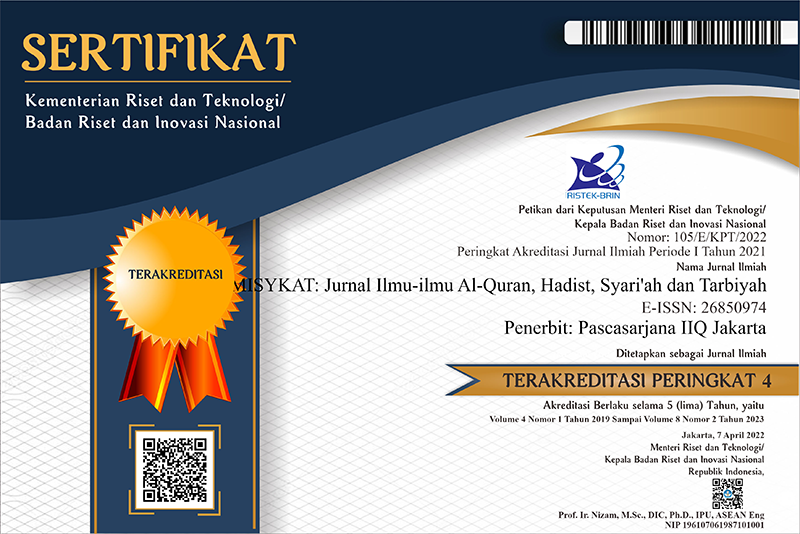
MENCARI FORMAT ILMU PENGETAHUAN BERBASIS QURAN
Abstract
Ilmu pengetahuan berbasis Qur‟an adalah alternatif untuk meningkatkan moralitas bangsa. Ilmu pengetahuan ini memiliki pendekatan ilmu dari berbagai sudut sehingga sebuah kepribadian manusia yang dibentuk adalah pribadi yang integral, utuh sebagai sosok yang berorientasi sempurna dunia dan akhirat. Pernah ada usaha untuk menjadikan kurikulum berbasis karakter sebagai panduan, diantaranya, munculnya kurikulum berbasis karakter tahun 2010 dimana diharapkan setiap mata pelajaran bermuatan nilai karakter kebaikan. Dilanjutkan dengan kurikulum berbasis penilitian dan scientifik pada tahun 2013 dimana karakter dijadikan sebagai sebuah kompetensi seperti K-1 dan K-2.
Tetapi usaha tersebut kurang fundamental karena epistemologi ilmu pengetahuan yang digunakan berasaskan nilainilai ideologi barat yang jauh dari moral. Usaha untuk menjadikan Qur‟an sebagai basis ilmu pengetahuan belum terealisasi hingga saat ini. Kalau begitu, ilmu pengetahuan berbasis Qur‟an bentuknya seperti apa? Bagaimana metodologi penafsiran ayat-ayat Quran seharusnya untuk bisa menghasilkan ilmu pengetahuan yang orisinil Qur‟ani? Dimana ilmu pengetahuan tersebut mampu menghantarkan manusia pada ahlak yang luhur juga membangun peradaban yang maju menandingi penemuan ilmuwan Barat.
References
Arma, Adnin, “Islamisasi Ilmu Pengetahuan Kontemporer”, Materi perkuliahan Islamic Worldview, di Program Magister Universitas Ibn Khaldun Bogor, Agustus 2008.
Corbin, Henry, The man of Light in Iranian Sufism, ColoradoUnited States of Amerika: Shambala Press, 1978.
Croce, Pietro, Vivisection or Science : An Investigation into Testing Drugs and Safeguarding Health, London: Zed Books, 1999.
Handrianto, Budi, Makalah, Islamisasi Sains: Sebuah upaya mengislamkan sains barat Modern, 2010.
Husaini, Adian, Wajah Peradaban Barat: Dari Hegemoni Kristen ke Dominasi Sekular-Liberal, Jakarta: Gema Insani Press, 2005.
Isaacs, Jeremy and Taylor Downing, Cold War, London : Bantam Press, 1998.
Kalin, Ibrahim, The Philosophy of Seyyed Hossein Nasr, ttp:, tp, th.
Khudi, Asrari, Sir Mohammad Iqbal, Lahore-Pakistan: Iqbal Academy, th.
Nasr, Seyyed Hossein, Sains dan Peradaban di Dalam Islam, Bandung : Penerbit Pustaka, 1418 H-1997 M.
Rusyd, Ibn, “Al-Kashfu an Manahijil Adillah fi Aqaidil Millah”, Syarh M. Abid Aljabiri, Markaz dirasat al wahdah al Arabiah, Beirut, 2001.
Sardar, Ziauddin, Rekayasa Masa Depan Peradaban Muslim, Ttp: Mizan, 1988.
Setia, Adi, Three Meanings of Islamic Science Toward Operationalizing Islamization of Knowledge, Center for Islam and Science : Free online Library, 2007.
Sukarta, Mad Rodja dan Ahmad Sastra, Kepemimpinan Organisasi Pesantren : Mengupas Budaya Organisasi Pesantren, Pendidikan karakter dan tantangan Pemikiran Pendidikan Islam, Bogor Jawa Barat : Darul Muttaqin Press 2010.
Trianto, Wawasan Ilmu Alamiah dasar: Prespektif Islam dan Barat, Jakarta : Prestasi Pustaka Publisher, 2007.
Copyright Notice
Copyright and Licensing Terms of Jurnal MISYKAT
Authors who publish their work in Jurnal MISYKAT agree to the following terms:
-
Copyright Retention: Authors retain full copyright ownership of their articles without any restrictions.
-
Right of First Publication: Authors grant Jurnal MISYKAT the right of first publication, allowing the journal to publish and distribute the work simultaneously in both print and electronic formats.
-
Creative Commons Licensing: All articles published in Jurnal MISYKAT are licensed under a Creative Commons Attribution-ShareAlike 4.0 International License (CC BY-SA 4.0).
What does this mean for authors and readers? Under this license, anyone is free to:
Share: Copy and redistribute the material in any medium or format.
Adapt: Remix, transform, and build upon the material for any purpose, even commercially.
Under the following strict conditions:
Attribution: You must give appropriate credit, provide a link to the license, and indicate if changes were made. You may do so in any reasonable manner, but not in any way that suggests the licensor endorses you or your use.
ShareAlike: If you remix, transform, or build upon the material, you must distribute your contributions under the same license as the original.
-
Self-Archiving Policy: Authors are permitted and highly encouraged to post their work online (e.g., in institutional repositories, open-access repositories, or on their personal websites) after the official publication process is complete. This practice is encouraged as it can lead to productive academic exchanges, as well as earlier and greater citation of the published work.
Privacy Statement (Recommended addition for OJS)
The names and email addresses entered in this journal site will be used exclusively for the stated purposes of this journal and will not be made available for any other purpose or to any other party.