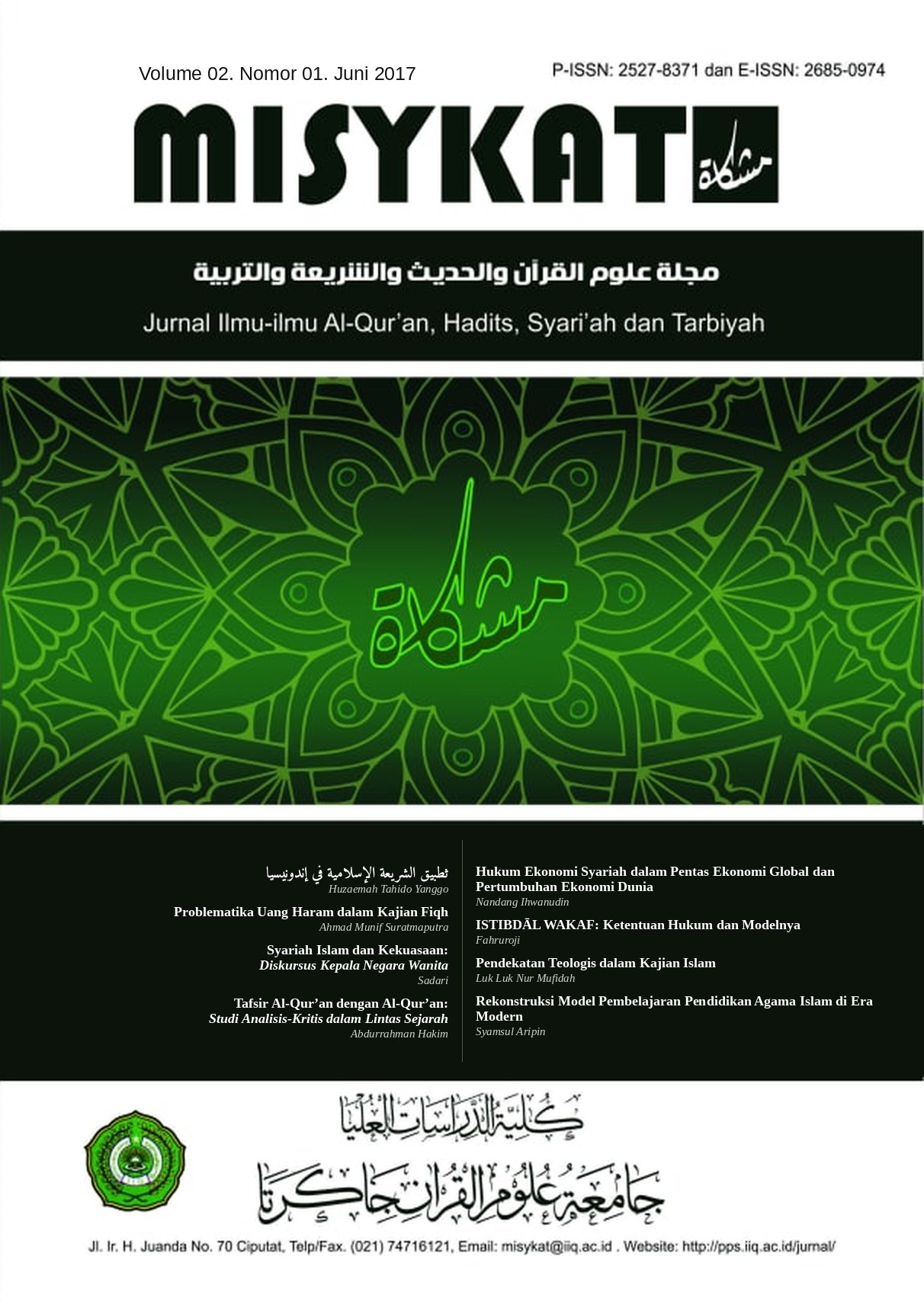
HUKUM EKONOMI SYARIAH DALAM PENTAS EKONOMI GLOBAL DAN PERTUMBUHAN EKONOMI DUNIA
Abstract
This article is motivated by the growth of Islamic economics worldwide, which indicates that there is something distinctive about the concept of Islamic economics, and that it may even offer a solution where the capitalist and socialist economic systems have been unable to contribute much to global economic development. The article concludes, first, that the economic systems known in the global economy are the capitalist, socialist and Islamic (Shari'ah) economic systems. Second, world economic growth declined from 2015 to 2019, unlike in regions that apply Islamic banking instruments. Third, the Islamic economy has continued to grow in terms of both assets and institutions. Fourth, the challenges facing Islamic economics internationally are the entrenched dominance of the capitalist system in the world economy, limited public understanding of Islamic finance and banking, and the scarcity of human resources who truly understand the Islamic economic system. Fifth, the opportunities to overcome these challenges include the public's enthusiastic response to conducting economic activities according to Shari'ah principles; positive trends in non-financial sectors, such as education and law, that support the development of the Islamic economy nationally and globally; the development of Islamic financial instruments expected to attract more investors and businesses into the national Islamic banking industry; and the potential for investment from Middle Eastern countries in the Islamic banking industry.
References
Braudel, Free Enterprisemand, Civilization and Capitalism, New York: tp. 1982.
Gidderns, Anthony , Kapitalisme dan Teori Sosial Modern Suatu Analisis Karya Tulis Marx, Burkheim dan Max Weber, Jakarta: UI Press, 1985.
Haron, Sudin, Islamic Banking: Rules and Regulations, Petaling Jaya: Pelanduk Publications. 1997.
http://www.bbc.com/indonesia/majalah/2016/04/160412_majalah _ekonomi_imf.
http://www.dakwatuna.com/ 2016/04/04/79866/ekonomi-islammenjadi-tren-dunia/#ixzz4RXUYSnA3, diakses tanggal 1 Desember 2016.
http://www.icmi.or.id/blog/2015/08/inilah-bank-syariah-denganasset-terbesar-di-dunia, diakses tanggal 1 Desember 2016.
http://www.worldbank.org/in/news/pressrelease/2016/06/07/worl d-bank-cuts-2016-global-growth-forecast.
https://id.wikipedia.org/wiki/Dewan_Kerjasama_untuk_Negara_ Arab_ di_Teluk.
Karim, Adiwarman, Bank Islam: Analisis Fiqh dan Keuangan, Jakarta: IIIT Indonesia. 2003.
Khobir, Abdul, “Islam dan Kapitalisme”, dalam jurnal Religia Vol. 13, No. 2, Oktober 2010.
Muhamad, Metodologi Penelitian Pemikiran Ekonomi Islam, Yogyakarta: Ekonisia Fakultas Ekonomi UII. t.th.
Radinson, Marxime, Islam and Capitalism, London: Allen Lane. 1974.
Suroso, Perekonomian Indonesia, Jakarta: Gramedia Pustaka Utama.1994.
Tim Penyusun Kamus Pusat Pembinaan dan Pengembangan Bahasa, Kamus Besar Bahasa Indonesia, Jakarta: Balai Pustaka, 1994.

This work is licensed under a Creative Commons Attribution-ShareAlike 4.0 International License.
Copyright Notice
Copyright and Licensing Terms of Jurnal MISYKAT
Authors who publish their work in Jurnal MISYKAT agree to the following terms:
-
Copyright Retention: Authors retain full copyright ownership of their articles without any restrictions.
-
Right of First Publication: Authors grant Jurnal MISYKAT the right of first publication, allowing the journal to publish and distribute the work simultaneously in both print and electronic formats.
-
Creative Commons Licensing: All articles published in Jurnal MISYKAT are licensed under a Creative Commons Attribution-ShareAlike 4.0 International License (CC BY-SA 4.0).
What does this mean for authors and readers? Under this license, anyone is free to:
Share: Copy and redistribute the material in any medium or format.
Adapt: Remix, transform, and build upon the material for any purpose, even commercially.
Under the following strict conditions:
Attribution: You must give appropriate credit, provide a link to the license, and indicate if changes were made. You may do so in any reasonable manner, but not in any way that suggests the licensor endorses you or your use.
ShareAlike: If you remix, transform, or build upon the material, you must distribute your contributions under the same license as the original.
-
Self-Archiving Policy: Authors are permitted and highly encouraged to post their work online (e.g., in institutional repositories, open-access repositories, or on their personal websites) after the official publication process is complete. This practice is encouraged as it can lead to productive academic exchanges, as well as earlier and greater citation of the published work.
Privacy Statement (Recommended addition for OJS)
The names and email addresses entered in this journal site will be used exclusively for the stated purposes of this journal and will not be made available for any other purpose or to any other party.