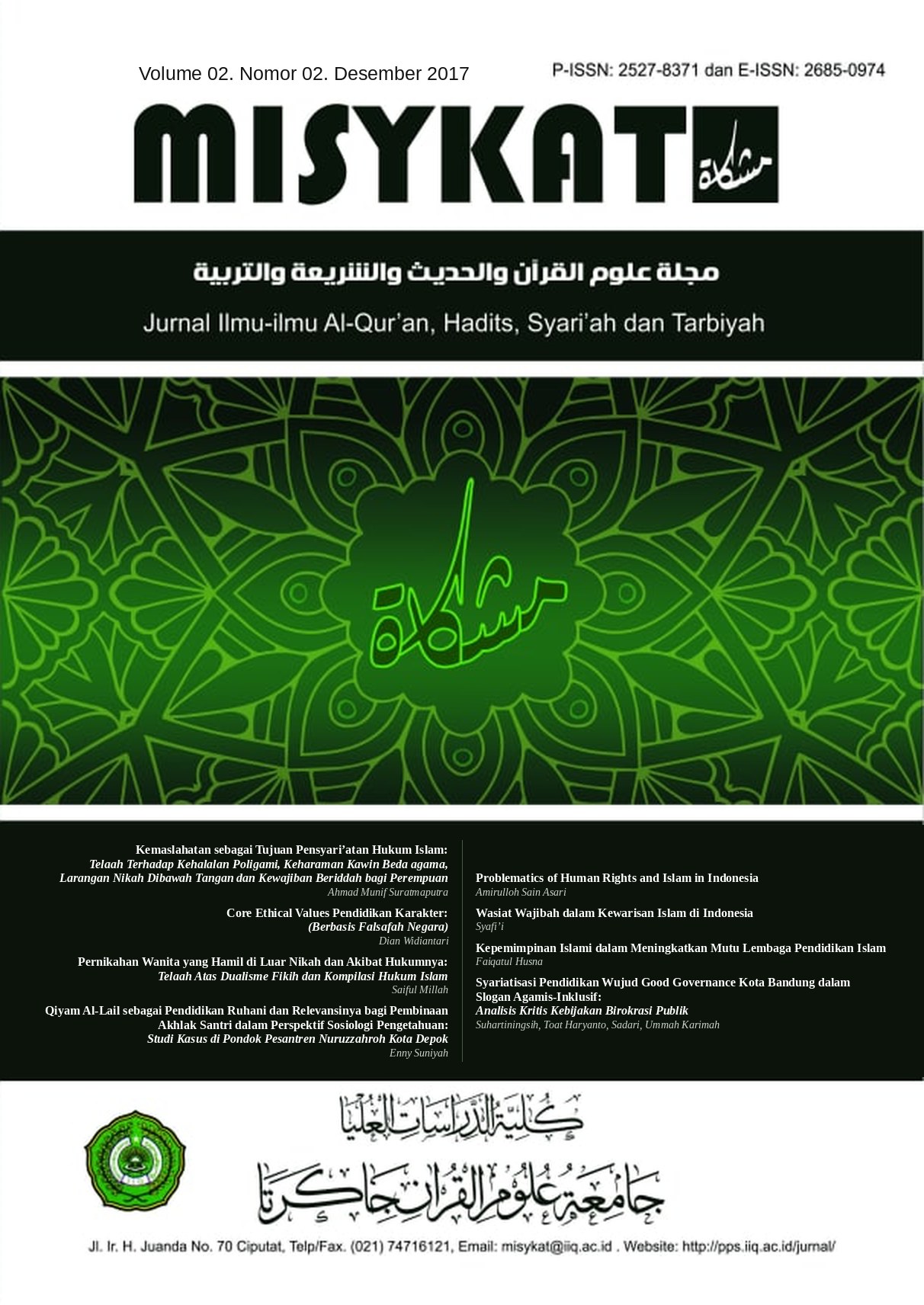
WASIAT WAJIBAH DALAM KEWARISAN ISLAM DI INDONESIA
Abstract
Islam is a hanif (upright) religion brought by an upright person, and is therefore a perfect religion, as stated in the last of the verses revealed by God Almighty. Islam thus addresses all aspects of life, including bequests (wasiyyah). A bequest is something that must be carried out in this worldly life, as it expresses the wishes of a person about to leave this transient world. Fulfilling the trust of a bequest is very important in distributing the estate, since the bequest must be executed before the heirs divide the inheritance. God Almighty has determined the distribution of the estate very precisely, whether it is distributed through inheritance or through bequest, supplemented by several hadiths that explain the matter of bequests. Nevertheless, not every statement a person makes must be executed as a bequest after death. Herein lies the uprightness of Islamic teaching: alongside the instruction to carry out bequests, there is also a provision for not carrying them out. This is what Islamic law calls istithna'iyyah, a system of exceptions. Through this system Islam is not rigid, inflexible or static; rather, it tends towards an elastic and flexible system that is always up to date.
References
Fiqr, tt.
Ali, Mohammad Daud, Hukum Islam: Pengantar Ilmu Hukum dan Tata Hukum Islam di Indonesia, Ttp : PT. Raja Grafindo Persada, 1998.
Al-Jaziri, Abdurrahman, al-Fiqhu ‘ala Mazahibi al-arba’ah, ttp : tp, tt.
Bismar Siregar, Perkawanin, Hibah dan Wasiat dalam Pandangan Hukum Bangsa, Penerbit Fakultas Hukum UI, Yogyakarta, 1985.
Direktorat Pembinaan Badan Peradilan Agama Islam Departemen Agama Republik Indonesia, Laporan Hasil Seminar Hukum Waris Islam, 1982.
Hamka, Tafsir al-Azhar.
Instruksi Presiden Nomor 1 Tahun 1991 tentang Penyebarluasan Kompilasi Hukum Islam.
Muhibbin, Moh, Abdul Wahid, Hukum Kewarisan Islam: sebagai Pembaharuan Hukum Positif di Indonesia, Jakarta : Sinar Grafita, 1994.
Nugraheni, Destri Budi, et. al, Pengaturan dan Implementasi Wasiat wajibah di Indonesia, Mimbar Hukum Volume 22 Nomor 2, Juni 2010.
Quthub, Sayyid, Tafsir fi Zhilalil Quran, Bairut : Kitab al-Arabi, 1973.
Rahman, Fatchur, Ilmu Waris, Cet. Ke-2, Bandung : Pustaka alMa‟arif, 1981.
Shihab, Quraish, Tafsir al-Misbah, Juz, ke 1, Jakarta : Lentera, 2000.
Suparman, Eman, Inti Sari Hukum Waris Indonesia, Bandung :
Mandar Maju, 1991.
Syarifudin, Amir, Hukum Kewarisan Islam, Jakarta : Kencana, 2008.
Thalib, Sajuti, Hukum Kewarisan Islam di Indonesia, Ttp : PT. Bina Aksara, 1981.
Undang-undang Nomor 48 Tahun 2009 tentang Kekuasaan Kehakiman.
Usman, Suparman, Hukum Kewarisan Islam di Indonesia, 1989.

This work is licensed under a Creative Commons Attribution-ShareAlike 4.0 International License.
Copyright Notice
Copyright and Licensing Terms of Jurnal MISYKAT
Authors who publish their work in Jurnal MISYKAT agree to the following terms:
-
Copyright Retention: Authors retain full copyright ownership of their articles without any restrictions.
-
Right of First Publication: Authors grant Jurnal MISYKAT the right of first publication, allowing the journal to publish and distribute the work simultaneously in both print and electronic formats.
-
Creative Commons Licensing: All articles published in Jurnal MISYKAT are licensed under a Creative Commons Attribution-ShareAlike 4.0 International License (CC BY-SA 4.0).
What does this mean for authors and readers? Under this license, anyone is free to:
Share: Copy and redistribute the material in any medium or format.
Adapt: Remix, transform, and build upon the material for any purpose, even commercially.
Under the following strict conditions:
Attribution: You must give appropriate credit, provide a link to the license, and indicate if changes were made. You may do so in any reasonable manner, but not in any way that suggests the licensor endorses you or your use.
ShareAlike: If you remix, transform, or build upon the material, you must distribute your contributions under the same license as the original.
-
Self-Archiving Policy: Authors are permitted and highly encouraged to post their work online (e.g., in institutional repositories, open-access repositories, or on their personal websites) after the official publication process is complete. This practice is encouraged as it can lead to productive academic exchanges, as well as earlier and greater citation of the published work.
Privacy Statement (Recommended addition for OJS)
The names and email addresses entered in this journal site will be used exclusively for the stated purposes of this journal and will not be made available for any other purpose or to any other party.