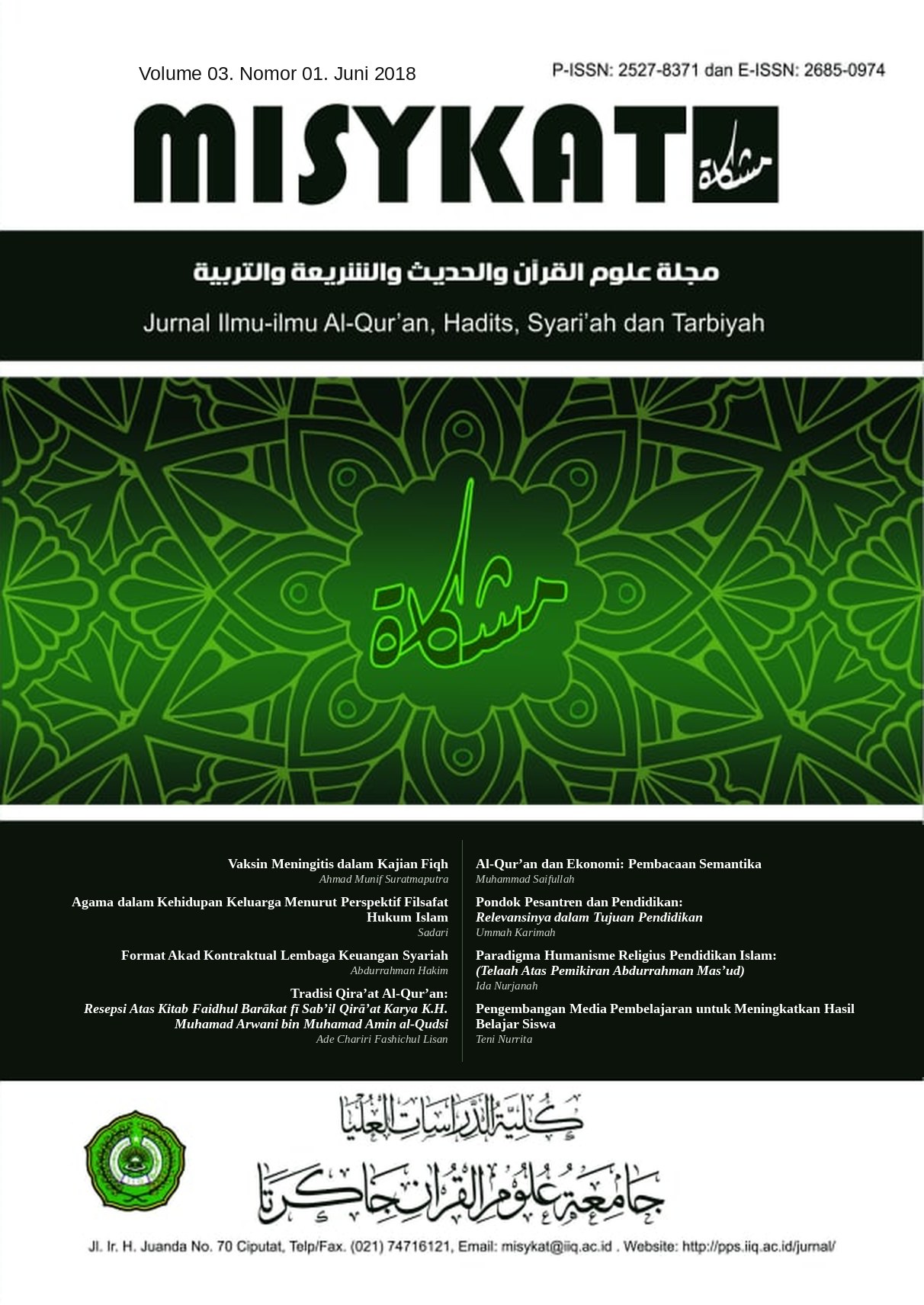
TRADISI QIRA’AT AL-QUR’AN
Resepsi Atas Kitab Faidhul Barākat fī Sab’il Qirā’at Karya K.H. Muhamad Arwani bin Muhamad Amin al-Qudsi
Abstract
This article analyses how the tradition of qira'at al-Qur'an, as part of the Qur'an itself and of the living Qur'an, also deserves serious reception, since the orality of the Qur'an is a vocal point at which many differences occur across regions and countries. There are several reasons why this study is worth undertaking. First, qira'at al-Qur'an is one of the pillars of the orality of the Qur'an, as every community and region has its own dialect, including the revelation of the Qur'an in Arabia in the seventh century in the Arabic language. Second, it seeks to determine the extent of the reception and influence in society of the study of the book Faid al-Barakat fi Sab' al-Qira'at by K.H. Muhammad Arwani bin Muhammad Amin al-Qudsi, which contains the seven readings (qira'at sab'ah) of the Qur'an, among alumni of the An-Nur Islamic boarding school, Ngrukem, Pendowoharjo, Sewon, Bantul, Yogyakarta. The writing of Faid al-Barakat fi Sab' al-Qira'at is itself an effort to preserve the oral tradition of the Qur'an.
References
Al-Qattan, Manna’ Khalil, Mabāhis fī Ulūmil Qur‟ān, terj. Mudzakir AS. Studi Ilmu-ilmu Qur‟an, Bogor: Pustaka Litera Antar Nusa, 2009.
Anwar, Rosihan, Biografi K.H. Muhamad Arwani Amin, Jakarta:
Depertemen Agama, 1987.
Baedhowi. Antropologi al-Qur‟an, Yogyakarta: LKiS Group, 2009.
Barir, Muhammad, Tradisi al-Qur‟an di Pesisir: jaringan Kiai
Dalam Transmisi Tradisi al-Qur‟an di Gerbang Islam Tanah Jawa, Yogyakarta: Nurmahera, 2017.
Berger, Peter L, The Social Construction of Reality, terj. Hasan Basari, Tafsir Sosial atas Kenyataan, Jakarta: LP3ES. 1990.
Gusmian, Islah, Khazanah Tafsir Indonesia: Dari Hermeneutika Hingga Ideologi, Jakarta: Teraju, 2002.
Hidayat, Asep Ahmad, Filsafat Bahasa: Mengungkap Hakikat Bahasa, Makna, dan Tanda, Bandung: PT Remaja
Rosdakarya, 2009.
Mattson, Ingrid, The Story of the Qur‟an, terj. R. Cecep Lukman,
Ulmul Qur‟an Zaman Kita, Jakarta: Zaman, 2013.
Mustaqim, Abdul, Madzahibut Tafsir: Peta Metodologi Penafsiran al-Qur‟an Periode Klasik hingga Kontemporer,
Yogyakarta: Nun Pustaka, 2003.
Neuwirth, Angelika, Locating the Qur‟an in the Epistemic Space of Late Antiquity, dalam Jurnal Ankara Universitesi Ilahiyat Fakultesi Dergisi, 2013.
Ong, Walter J. Orallity and Litteracy, terj. Rika Iffati, Kelisanan dan Keaksaraan, Yogyakarta: Gading. 2013.
Riyanto, Geger, Peter L. Berger, Perspektif Metateori Pemikiran, Jakarta: LP3ES, 2009.
Syamsuddin, Sahiron, Hermeneutika dan Pengembangan Ulumul Qur‟an, Yogyakarta: Pesantren Nawesea Press, 2009.
_______, at.al, Islam, Tradisi dan Peradaban, Yogyakarta: Bina Mulia Press, 2012.
Syukri, Ahmad Khalid, at.al, Muqaddimah „Ilmu al-Qirā‟at, ‘Aman: Dār ‘Umār, 2001.
Taufiq, at.al, Kafa Bihi: Kumpulan Dzikir dan Do‟a, Yogyakarta: Pon-Pes An-Nur, 2013.
Zuhdi, Nurdin, Pasaraya Tafsir Indonesia: Dari Kontestasi Metodologi hingga Kontekstualisasi, Yogyakarta: Kaukaba Dipantara, 2014.

This work is licensed under a Creative Commons Attribution-ShareAlike 4.0 International License.
Copyright Notice
Copyright and Licensing Terms of Jurnal MISYKAT
Authors who publish their work in Jurnal MISYKAT agree to the following terms:
-
Copyright Retention: Authors retain full copyright ownership of their articles without any restrictions.
-
Right of First Publication: Authors grant Jurnal MISYKAT the right of first publication, allowing the journal to publish and distribute the work simultaneously in both print and electronic formats.
-
Creative Commons Licensing: All articles published in Jurnal MISYKAT are licensed under a Creative Commons Attribution-ShareAlike 4.0 International License (CC BY-SA 4.0).
What does this mean for authors and readers? Under this license, anyone is free to:
Share: Copy and redistribute the material in any medium or format.
Adapt: Remix, transform, and build upon the material for any purpose, even commercially.
Under the following strict conditions:
Attribution: You must give appropriate credit, provide a link to the license, and indicate if changes were made. You may do so in any reasonable manner, but not in any way that suggests the licensor endorses you or your use.
ShareAlike: If you remix, transform, or build upon the material, you must distribute your contributions under the same license as the original.
-
Self-Archiving Policy: Authors are permitted and highly encouraged to post their work online (e.g., in institutional repositories, open-access repositories, or on their personal websites) after the official publication process is complete. This practice is encouraged as it can lead to productive academic exchanges, as well as earlier and greater citation of the published work.
Privacy Statement (Recommended addition for OJS)
The names and email addresses entered in this journal site will be used exclusively for the stated purposes of this journal and will not be made available for any other purpose or to any other party.