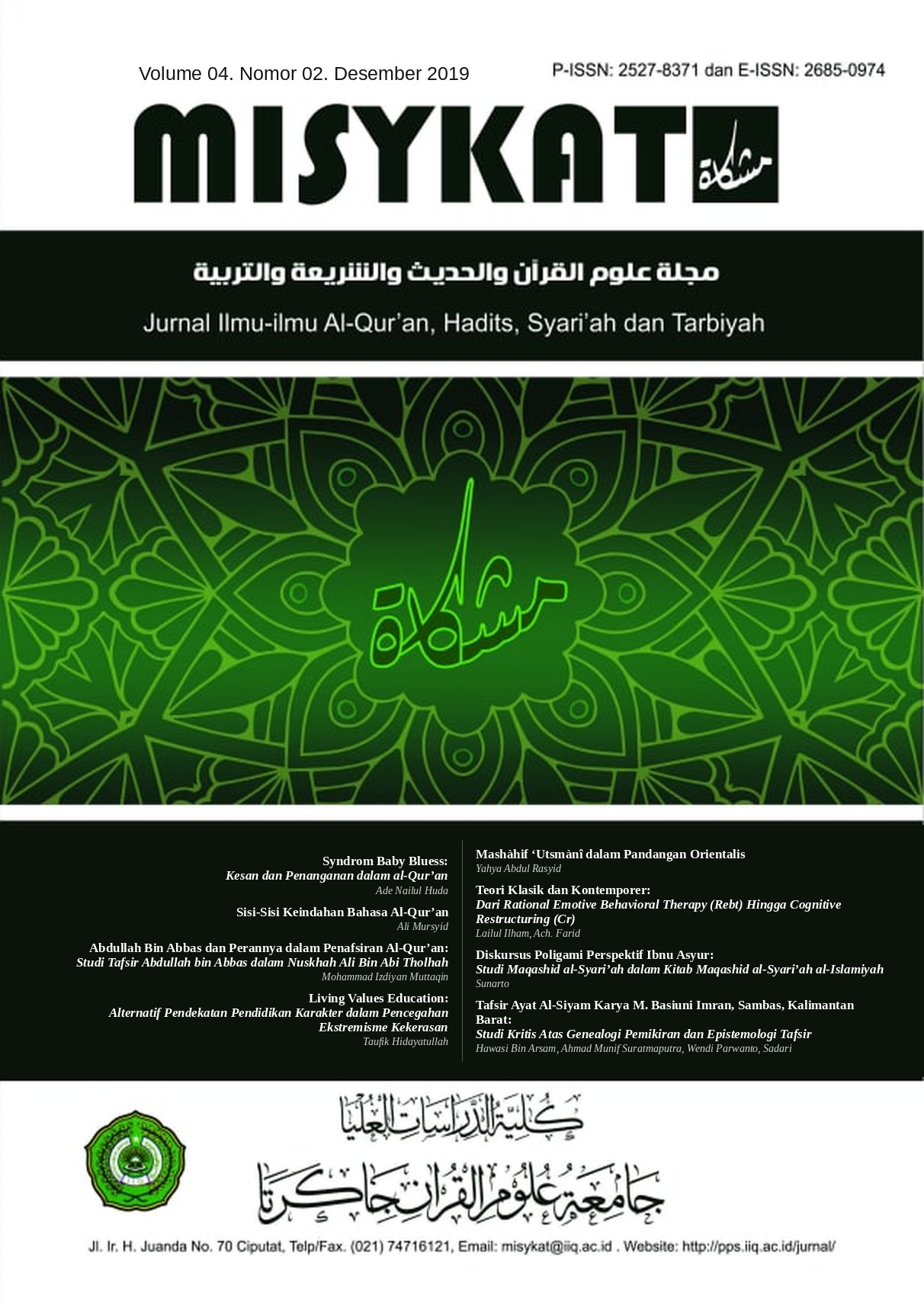
MASHÀHIF ‘UTSMÀNÎ DALAM PANDANGAN ORIENTALIS
Abstract
Uneven knowledge of the 'Uthmanic codices (masahif 'Uthmaniyyah) in general and of the science of 'Uthmanic orthography (rasm 'Uthmani) in particular has led to prolonged controversy, both among Muslims and between Muslims and Orientalists. Very few people know that the Qur'an was revealed in seven ahruf (seven or many modes of reading) in order to accommodate the various modes of reading of reciters and memorisers of the Qur'an in particular and of the Muslim community in general. The same applies to the history of, and the facts about, the difference between the compilation of the suhuf into a mushaf in the time of the Caliph Abu Bakr and the codification and recopying of the mushaf into masahif encompassing the seven ahruf in the time of the Caliph 'Uthman b. 'Affan. The controversy intensified when Orientalists questioned the authenticity and integrity of the 'Uthmanic codices, claiming that grammatical errors and anomalous differences in orthography and reading exist both among the 'Uthmanic codices themselves and between them and the private pre-'Uthmanic codices. This paper seeks to unravel and map the problem so that, when differences of opinion arise, it becomes clear which views have a strong scholarly foundation and which are merely weak conjectures or even baseless accusations, so that the controversy does not escalate but becomes a mutually constructive dialogue towards peace, harmony and mutual understanding.
References
Al-Qurthubi, Abu Abd Allah Muhammad ibn Ahmad al-Anshari, al-Jami‟ li Ahkam al-Qur‟an, Kairo: Dar al-Hadits, 1426/2005.
Al-Zamakhsyari, Abu al-Qasim Mahmud ibn „Umar, AlKasysyaf „an Haqaiq al-Tanzil wa „Uyun al-Aqawil fi Wujuh al-Ta‟wil, Beirut: Dar al-Fikr, 1426-7/2006, 1: 582.
Amal, Taufik Adnan, Islam dan Tantangan Modernitas. Studi atas Pemikiran Hukum Fazlur Rahman, Jakarta: Mizan, 1993.
As-Suyuthi, Imam Jalaluddin, alih bahasa: Farikh Marzuki
Ammar, Samudra U‟lumul Qur‟an, Surabaya: PT. Bina
Ilmu Offset, t.th.
Baidhowi, Antropologi Al Qur‟an, cet. II, Yogyakarta: LkiS, 2013.
Dahlan & Zaka Alfarisi, Asbâbun Nuzûl, cet. 2, Bandung: Diponegoro, 2011.
Departemen Agama RI, al-Qur‟an Terjemah Per Kata, Jakarta: Robbani, 2012.
Fathoni, Ahmad, Ilmu Rasm Utsmani, Jakarta, Jakarta: IIQ Press, 2013.
Fathoni, Ahmad, Petunjuk Praktis Tahsin Tartil al-Qur‟an Metode Maisûrâ, Bogor: CV. Duta Grafika, 2016.
Noer, Kautsar Azhari, Mempersoalkan Otensitas al-Qur‟an
Bersama Theodor Noldeke, Jurnal Dialog PeradabanTitik Temu, Jakarta : Nurcholis Madjid Society, 2010, vol. 3, No. 1
Noldeke, Theodor, et.al, Tarikh al-Qur‟an, diterjemahkan kedalam bahasa arab oleh Georges Tamer, Beirut: Konrad Adenauer-Stiftung, 2004.
Noldeke, Theodor, et.al., Geschichte des Qorans, Leipzig:
Dietyerich‟se, 1909-1938.
Said, Edward W., Orientalism, New York : Vintage Books, 1979, diterjemahkan oleh: Asep Hikmat, Orientalism, Bandung: Pustaka, 2012.
Salim, Fahmi, Kritik Terhadap Studi al-Qur‟an Kaum Liberal, cet. V, Depok: Perspektif, 2017.
Shihab, M. Quraish, Tafsir al-Misbah, cet. 1, Ciputat: Lentera Hati, 2017.
Widayati, Romlah, Ilmu Qiro‟at 1, cet. Ke 2, Ciputat Tangerang: IIQ Jakarta Press, 2015.

This work is licensed under a Creative Commons Attribution-ShareAlike 4.0 International License.
Copyright Notice
Copyright and Licensing Terms of Jurnal MISYKAT
Authors who publish their work in Jurnal MISYKAT agree to the following terms:
-
Copyright Retention: Authors retain full copyright ownership of their articles without any restrictions.
-
Right of First Publication: Authors grant Jurnal MISYKAT the right of first publication, allowing the journal to publish and distribute the work simultaneously in both print and electronic formats.
-
Creative Commons Licensing: All articles published in Jurnal MISYKAT are licensed under a Creative Commons Attribution-ShareAlike 4.0 International License (CC BY-SA 4.0).
What does this mean for authors and readers? Under this license, anyone is free to:
Share: Copy and redistribute the material in any medium or format.
Adapt: Remix, transform, and build upon the material for any purpose, even commercially.
Under the following strict conditions:
Attribution: You must give appropriate credit, provide a link to the license, and indicate if changes were made. You may do so in any reasonable manner, but not in any way that suggests the licensor endorses you or your use.
ShareAlike: If you remix, transform, or build upon the material, you must distribute your contributions under the same license as the original.
-
Self-Archiving Policy: Authors are permitted and highly encouraged to post their work online (e.g., in institutional repositories, open-access repositories, or on their personal websites) after the official publication process is complete. This practice is encouraged as it can lead to productive academic exchanges, as well as earlier and greater citation of the published work.
Privacy Statement (Recommended addition for OJS)
The names and email addresses entered in this journal site will be used exclusively for the stated purposes of this journal and will not be made available for any other purpose or to any other party.