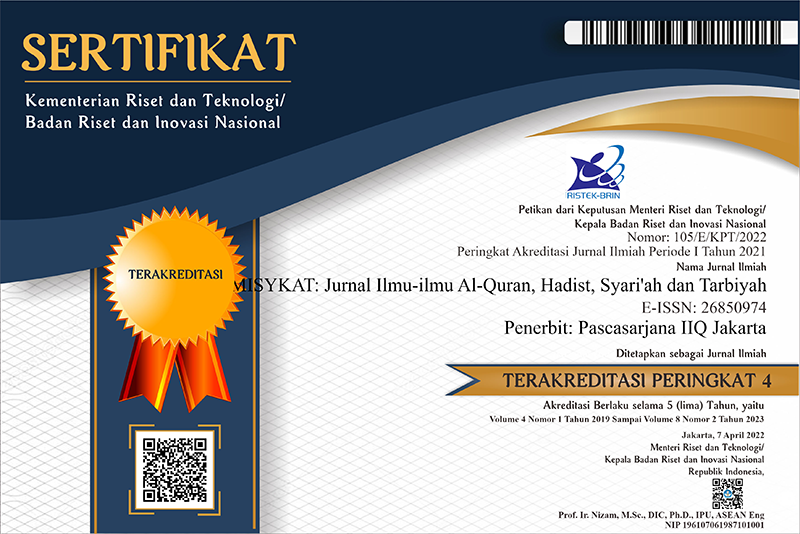
TAFSIR AYAT-AYAT PANDEMI
Studi Atas Fatwa Majelis Ulama Indonesia (MUI)
Abstract
Saat dunia dilanda wabah, termasuk merebak ke Indonesia, umat Islam yang mayoritas di negeri ini, tentu saja menerima dampak hebatnya. Umat Islam bukan hanya waspada menghadapi serangan virus, tetapi juga gagap terkait bagaimana beribadah di masa maraknya wabah Covid-19 ini. Maka kemudian MUI mengeluarkan beberapa fatwa untuk merespon kebutuhan umat Islam di negeri ini.
Dalam artikel ini, dikaji fatwa-fatwa apa saja yang dikeluarkan MUI di saat merebaknya pandemi Covid-19 ini, isinya apa saja, untuk keperluan apa saja. Juga ayat-ayat alQur‟an yang mana saja yang menjadi dalilnya, serta terutama mengenai tafsir dan penjelasan ulama mufassir mengenai ayatayat tersebut.
Hasil kajian ini menjelaskan bahwa berdasarkan penfasiran ayat-ayat al-Qur‟an yang dijadikan dalil dalam fatwafatwa MUI di masa pandemi Covid-19, memang penafsiran ayatayat tersebut menunjukkan apa yang dimaksud oleh fatwa, demi mencegah kemudharatan memberi kemudahan kepada umat Islam.
References
Al-Atsqalani, Ahmad bin Ali bin Hajar, Fath al-Bari, jilid 8, TK: Maktabat al-Salafiyah, t.t.
Al-Mahalli, Jalaluddin, dan Jalaluddin as-Suyuthi, ditahqiq Fakhruddin Qabbawah, Tafsir al-Jalalain al-Muyassar, Beirut, Maktabah Lubnan Nasyirun, 2003.
Al-Qurthubi, Abi „Abdillah Muhammad bin Ahmad bin Abi Bakr, al-Jami‟ li Ahkam al-Qur‟an, Jilid 3, Beirut: Muasasah ar-Risalah, 2006.
As-Suyuthi, Jalaluddin, al-Itqan fi „Ulum al-Qur‟an, Riyadh:
Majma‟ Malik Fahd, t.t.
As-Syaukani, Muhammad bin Ali Muhammad, Tafsir Fath alQadir, Beirut: Dar al-Ma‟rifah, 2007.
Fatwa MUI No. 14 tahun 2020, tentang Pedoman Penyenggaraan Ibadah dalam Situasi Terjadi Wabah Covid-19.
Fatwa MUI No. 17 tahun 2020, tentang Pedoman Kaifiat Shalat Bagi Tenaga Kesehatan yang Memakai Pelindung DIri Pada Saat Menangani dan Merawat Pasien Covid-19.
Fatwa MUI No. 18 tahun 2020, tentang Pedoman Pengurusan Jenazah (Tajhiz Jana‟iz) Muslim yang Terinfeksi Covid19.
Fatwa MUI No. 23 tahun 2020, tentang Pemanfaatan Harta Zakat, Infaq dan Shadaqah untuk Penangulangan Wabah Covid-19 dan Dampaknya.
Fatwa MUI No. 28 tahun 2020 tentang Panduan Takbir dan Shalat „Idul Fitri Saat Pandemi Covid-19.
Fatwa MUI No. 31 tahun 2020, tentang Penyelenggaraan Shalat
Jum‟at dan jama‟ah untuk Mencegah Penyebaran Covid-19.
Ibnu „Aysur, Muhammad Thahir, Tafsir at-Tahrir wa at-Tanwir, jilid 28, Tunisia: Dar at-Tunis li an-Nasyr, t.t.
Thanthawi, Syeikh, al-Tafsir al-Wasith, jilid 3, Kairo: Majma‟ alBuhuts al-Islamiyah al-Azhar, 1992.
Tim Penyusun, al-Tafsir al-Muyassar, cet. II, Madinah: Majma‟ al-Malik Fahd, 2009.
Copyright Notice
Copyright and Licensing Terms of Jurnal MISYKAT
Authors who publish their work in Jurnal MISYKAT agree to the following terms:
-
Copyright Retention: Authors retain full copyright ownership of their articles without any restrictions.
-
Right of First Publication: Authors grant Jurnal MISYKAT the right of first publication, allowing the journal to publish and distribute the work simultaneously in both print and electronic formats.
-
Creative Commons Licensing: All articles published in Jurnal MISYKAT are licensed under a Creative Commons Attribution-ShareAlike 4.0 International License (CC BY-SA 4.0).
What does this mean for authors and readers? Under this license, anyone is free to:
Share: Copy and redistribute the material in any medium or format.
Adapt: Remix, transform, and build upon the material for any purpose, even commercially.
Under the following strict conditions:
Attribution: You must give appropriate credit, provide a link to the license, and indicate if changes were made. You may do so in any reasonable manner, but not in any way that suggests the licensor endorses you or your use.
ShareAlike: If you remix, transform, or build upon the material, you must distribute your contributions under the same license as the original.
-
Self-Archiving Policy: Authors are permitted and highly encouraged to post their work online (e.g., in institutional repositories, open-access repositories, or on their personal websites) after the official publication process is complete. This practice is encouraged as it can lead to productive academic exchanges, as well as earlier and greater citation of the published work.
Privacy Statement (Recommended addition for OJS)
The names and email addresses entered in this journal site will be used exclusively for the stated purposes of this journal and will not be made available for any other purpose or to any other party.