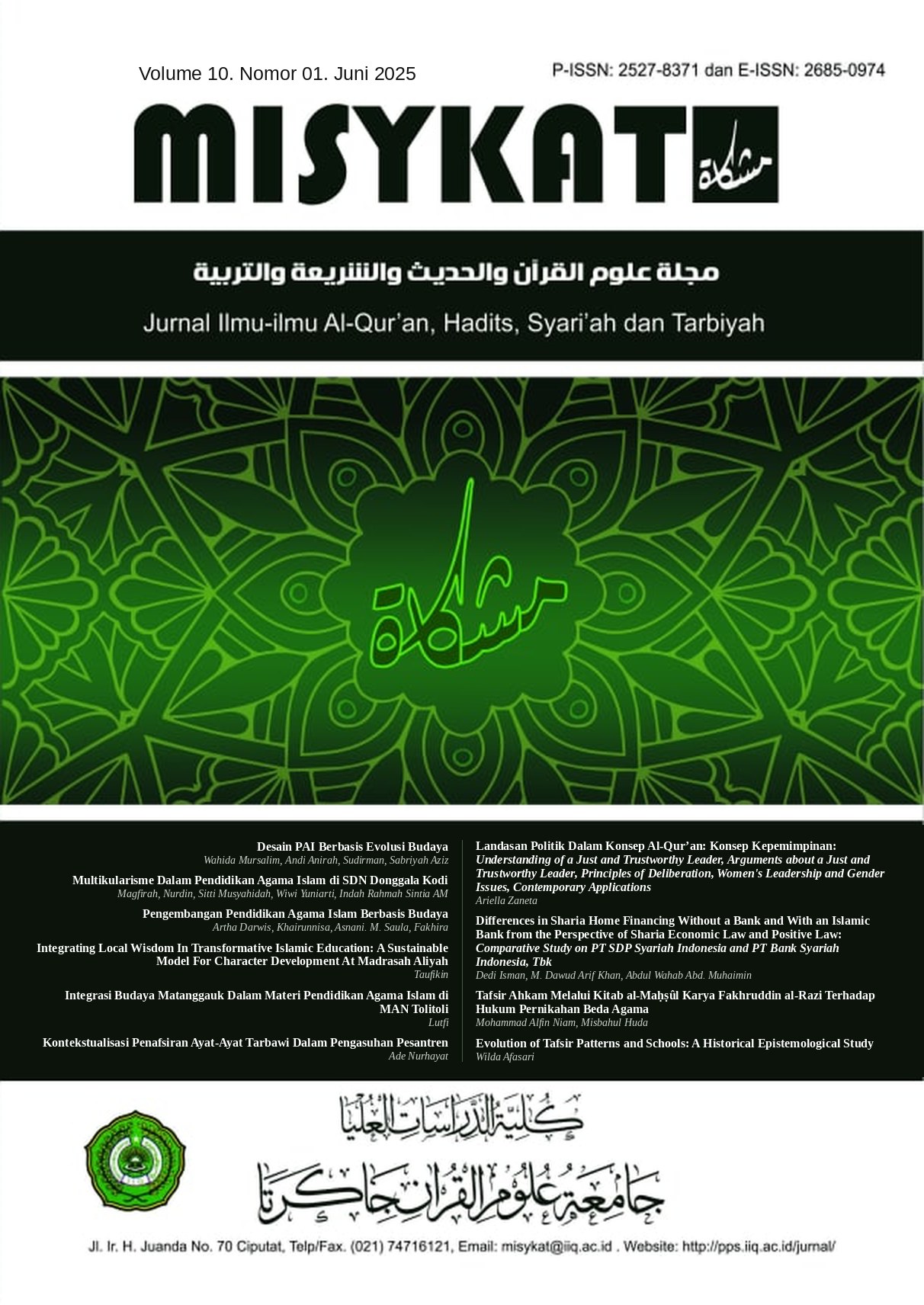
Desain PAI Berbasis Evolusi Budaya
Abstract
- The design of Islamic Religious Education (PAI) based on cultural evolution is the main focus of this research, considering the rich cultural diversity of Indonesia. The study aims to explore the relevance of the PAI curriculum within the socio-cultural context of the community, given the existing gap between dogmatic teaching materials and the realities of students' lives. The method employed is a qualitative approach with a case study, involving in-depth interviews, observations, and document analysis in schools with high cultural diversity. The research findings indicate that the design of PAI that integrates local cultural elements enhances students' understanding and positive attitudes towards religion. As many as 78 percent of students feel they better understand religious values when taught within the context of their culture. Recommendations include the need for training for teachers to teach culturally-based materials and to improve collaboration between schools, parents, and the community. This research is expected to contribute significantly to the development of more inclusive and relevant religious education.
References
Angrosino, M. (2007). Doing Cultural Anthropology.Waveland Press.
Badan Pusat Statistik. (2021). Statistik Sosial dan Budaya Indonesia
Banks, J. A. (2016). Multicultural Education: Characteristics and Goals. In Multicultural Education: Issues and Perspectives. Wiley.
Braun, V., & Clarke, V. (2006). Using thematic analysis in psychology. Qualitative Research in Psychology, 3(2), 77-101.
Badan Pusat Statistik (BPS). (2021). Statistik Pendidikan 2021. Jakarta: BPS.
Creswell, J. W. (2014). Research Design: Qualitative, Quantitative, and Mixed Methods Approaches. Publications.SAGE
Fatimah, N. (2019). Pengaruh Konteks Budaya terhadap Motivasi Belajar Agama. Jurnal Pendidikan Agama, 12(2), 123-134
Hidayah, N. (2020). Peran Guru dalam Pendidikan Agama Islam. Jurnal Pendidikan Agama Islam, 5(1), 15-30
Kurniawan, A. (2020). Peran Masyarakat dalam Pendidikan Agama. Jurnal Pendidikan dan Masyarakat, 5(1), 45-56.
Kementerian Pendidikan dan Kebudayaan Republik Indonesia. (2020). Laporan Penelitian Pendidikan.
Nurhayati, S. (2020). Keterhubungan Materi PAI dengan Kehidupan Siswa: Sebuah Studi Kasus. Jurnal Pendidikan Islam.
Nurhadi, A. (2021). Dialog Antarbudaya dalam Pendidikan: Membangun Toleransi dan Pengertian. Jurnal Pendidikan dan Kebudayaan.
Rahman, A. (2021). Pengaruh Budaya Lokal terhadap Pemahaman Agama Siswa. Jurnal Penelitian Pendidikan, 8(2), 45-60.
Rahman, H. (2021). Integrasi Budaya dalam Pendidikan Agama: Studi Kasus di Sekolah Dasar. Jurnal Pendidikan Islam, 8(3), 200-210.
Sari, R. (2019). Keterlibatan Orang Tua dalam Pendidikan Agama. Jurnal Ilmu Pendidikan, 12(3), 100-115.
Setiawan, R. (2021). Pelatihan Guru dalam Implementasi Kurikulum Agama Berbasis Budaya. Jurnal Pendidikan dan Pelatihan, 15(4), 301-315.
Suhadi, M. (2020). Desain Kurikulum Pendidikan Agama Islam yang Relevan dengan Budaya Lokal. Jurnal Kurikulum dan Pembelajaran, 9(1), 67-78
Yulianto, E. (2022). Keterkaitan Budaya dan Agama dalam Pendidikan. Jurnal Agama dan Budaya, 11(2), 150-160
Copyright (c) 2025 MISYKAT: Jurnal Ilmu-ilmu Al-Quran Hadits Syari'ah dan Tarbiyah

This work is licensed under a Creative Commons Attribution-ShareAlike 4.0 International License.
Copyright Notice
Copyright and Licensing Terms of Jurnal MISYKAT
Authors who publish their work in Jurnal MISYKAT agree to the following terms:
-
Copyright Retention: Authors retain full copyright ownership of their articles without any restrictions.
-
Right of First Publication: Authors grant Jurnal MISYKAT the right of first publication, allowing the journal to publish and distribute the work simultaneously in both print and electronic formats.
-
Creative Commons Licensing: All articles published in Jurnal MISYKAT are licensed under a Creative Commons Attribution-ShareAlike 4.0 International License (CC BY-SA 4.0).
What does this mean for authors and readers? Under this license, anyone is free to:
Share: Copy and redistribute the material in any medium or format.
Adapt: Remix, transform, and build upon the material for any purpose, even commercially.
Under the following strict conditions:
Attribution: You must give appropriate credit, provide a link to the license, and indicate if changes were made. You may do so in any reasonable manner, but not in any way that suggests the licensor endorses you or your use.
ShareAlike: If you remix, transform, or build upon the material, you must distribute your contributions under the same license as the original.
-
Self-Archiving Policy: Authors are permitted and highly encouraged to post their work online (e.g., in institutional repositories, open-access repositories, or on their personal websites) after the official publication process is complete. This practice is encouraged as it can lead to productive academic exchanges, as well as earlier and greater citation of the published work.
Privacy Statement (Recommended addition for OJS)
The names and email addresses entered in this journal site will be used exclusively for the stated purposes of this journal and will not be made available for any other purpose or to any other party.