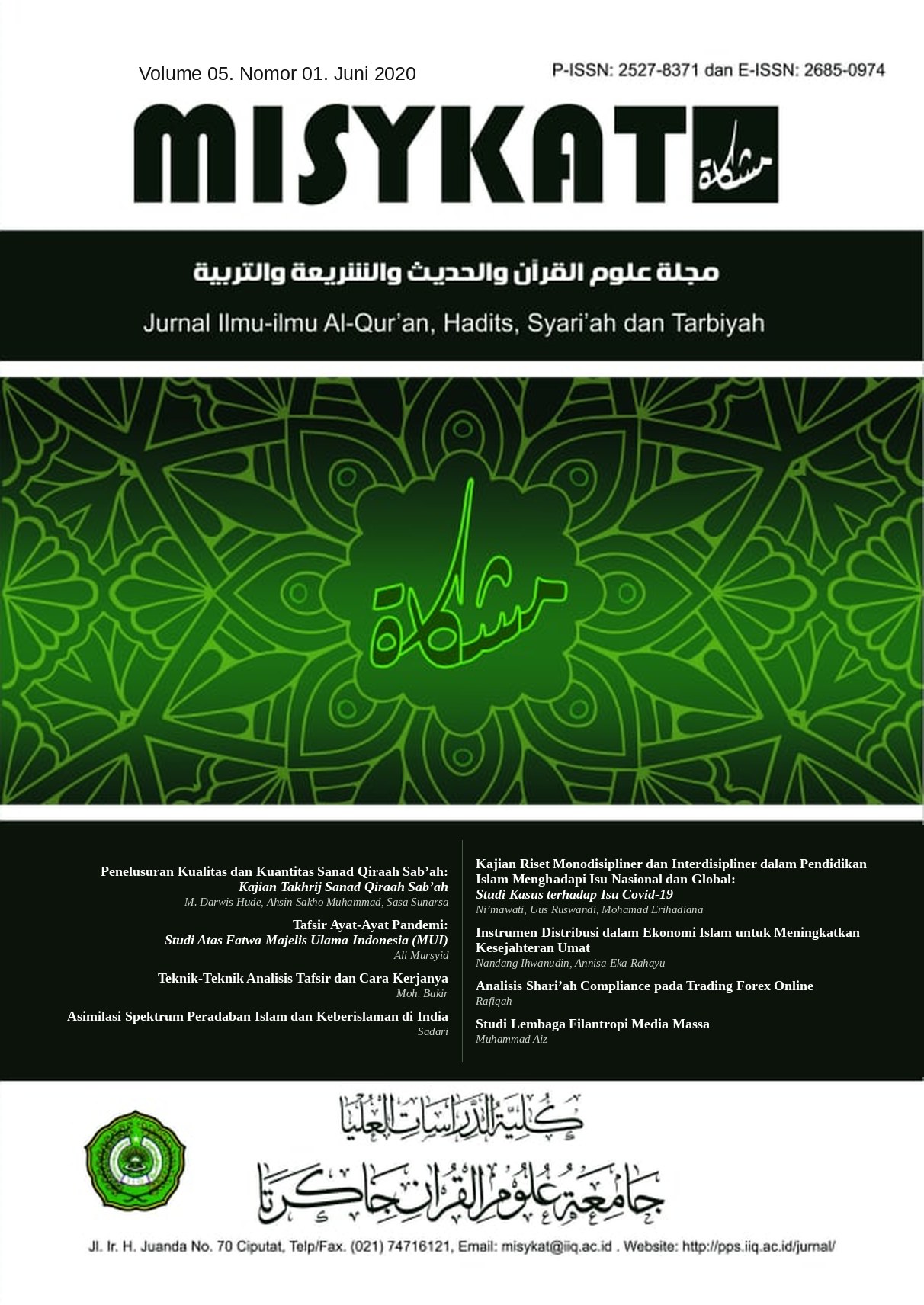
KAJIAN RISET MONODISIPLINER DAN INTERDISIPLINER DALAM PENDIDIKAN ISLAM MENGHADAPI ISU NASIONAL DAN GLOBAL
Studi Kasus terhadap Isu Covid-19
Abstract
This research is motivated by the current public discourse on the Covid-19 pandemic. Some people take the outbreak lightly, saying that death has already been determined by God Almighty, while others take it seriously and seek to avoid it and to find prevention strategies and solutions. On this basis, it is important to study monodisciplinary and interdisciplinary approaches in Islamic education to national and global issues through a case study of Covid-19. The aim of this research is to analyse the Covid-19 pandemic through a monodisciplinary approach of Islamic Religious Education (PAI), an intradisciplinary approach within the PAI cluster of sciences, and an interdisciplinary approach linking PAI and its cluster of sciences with other relevant disciplines. The study uses a descriptive-analytical method with a qualitative approach based on library sources. The results are as follows. First, from the monodisciplinary PAI approach, the Covid-19 pandemic is a creation of God Almighty that must be responded to appropriately. Second, from a transdisciplinary approach through kalam, fiqh, hadith and the history of Islamic civilisation, attitudes and measures for dealing with Covid-19 are found in the practice of the Prophet and his Companions and in the understanding of the scholars. Third, from a multidisciplinary approach: according to virologists, the outbreak is caused by a new type of coronavirus called novel coronavirus 2019 (2019-nCoV); according to pharmacology, it is treated with antiviral drugs; according to health science, people must keep their distance from those infected and maintain hygiene; and according to economists and the government, the pandemic affects the economic sector, so a lockdown cannot be implemented.
References
Amerika,” Humaniora, No.7, Januari-Maret 1998.
Akaha, Akhmad Zulfaidin, ed. Psikologi Anak dan Remaja Muslim, Jakarta Timur: Pustaka al-Kautsar, 2001.
Daradjat, Zakiah, Metodik Khusus Pengajaran Agama Islam, cet.ke-1, Jakarta: Bumi Aksara,1995.
Fatwa MUI Nomor 14 tahun 2020.
Getteng, Abd. Rahman, Pendidikan Islam dalam Pembangunan, Ujung Pandang: Yayasan al-Ahkam, 1997.
Ihwanudin, Nandang, “Hukum Ekonomi Syariah dalam Pentas Ekonomi Global dan Pertumbuhan Ekonomi Dunia”, Jurnal Misykat Volume 02 No. 01, 2017.
Kartodirdjo, Sartono, Pemikiran dan Perkembangan Historiografi Indonesia: Suatu Alternatif, Jakarta: Gramedia, 1982.
Mujtaba, Saifuddin, “Studi Islam Interdisipliner: Sebuah
Keniscayaan”, Volume II, Number 2, Juli-September 2015.
Pickering, Michael, (ed.), Research Methods for Cultural Studies, 2008.
Prentice, A.E, “Introduction” dalam Information Science-The Interdisciplinary Context, (ed. J. M. Pemberton dan A.E. Prentice, New York: Neal-Schuman Publishers, 1990.
Tim Pokja Akademik, Kerangka Dasar Keilmuan dan Pengembangan Kurikulum Universitas Islam Negeri
(UIN) Sunan Kalijaga Yogyakarta. Yogyakarta: UIN Press, 2006.
Yusuf, Z., Pendidikan Efektif Agama Islam, Jakarta: IKIP, 1988.

This work is licensed under a Creative Commons Attribution-ShareAlike 4.0 International License.
Copyright Notice
Copyright and Licensing Terms of Jurnal MISYKAT
Authors who publish their work in Jurnal MISYKAT agree to the following terms:
-
Copyright Retention: Authors retain full copyright ownership of their articles without any restrictions.
-
Right of First Publication: Authors grant Jurnal MISYKAT the right of first publication, allowing the journal to publish and distribute the work simultaneously in both print and electronic formats.
-
Creative Commons Licensing: All articles published in Jurnal MISYKAT are licensed under a Creative Commons Attribution-ShareAlike 4.0 International License (CC BY-SA 4.0).
What does this mean for authors and readers? Under this license, anyone is free to:
Share: Copy and redistribute the material in any medium or format.
Adapt: Remix, transform, and build upon the material for any purpose, even commercially.
Under the following strict conditions:
Attribution: You must give appropriate credit, provide a link to the license, and indicate if changes were made. You may do so in any reasonable manner, but not in any way that suggests the licensor endorses you or your use.
ShareAlike: If you remix, transform, or build upon the material, you must distribute your contributions under the same license as the original.
-
Self-Archiving Policy: Authors are permitted and highly encouraged to post their work online (e.g., in institutional repositories, open-access repositories, or on their personal websites) after the official publication process is complete. This practice is encouraged as it can lead to productive academic exchanges, as well as earlier and greater citation of the published work.
Privacy Statement (Recommended addition for OJS)
The names and email addresses entered in this journal site will be used exclusively for the stated purposes of this journal and will not be made available for any other purpose or to any other party.