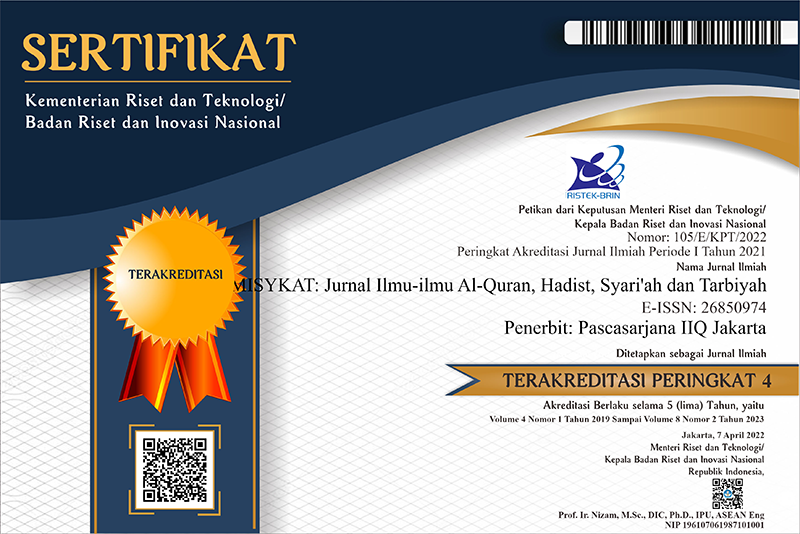
Al-Qur’an Dalam Kajian Kontemporer
Abstract
The Qur'an is a law and a way of life for friends, the food for their hearts, the decoration of their eyelids. Thus, its influence is very visible in their education and direction of life. They are a generation of pioneers and role models to emulate. Indeed, the companions of the Prophet were the first generation to feel when the Qur'an came down to the Prophet Muhammad. The Prophet received the Qur'an from Gabriel and also directly from Allah. Then he conveyed to his friends when he came down without lacking or forgetting a single letter. The Companions heard the Qur'an from the Prophet as if he had come down directly to them. The verses of the Qur'an inspire reason and remind people to do good deeds, and also call to think about the creation of creatures. The companions heard these verses. If their life is not in accordance with the Qur'an, they immediately change their lifestyle with safe guidelines, according to what they understand from the Qur'an.
References
Al-Baghdadi, Abu Mansur. T.t. al-Farq bain al-Firaq. Kairo: Maktabah Subeih
Al-Maroghi, Ahmad Mustofa. 1946. Tafsir al-Maraghi. Mesir: Musthofa al-Babi al-Halabi
Al-Nasysyar, Dr. Ali Sami. 1965. Nas’atu al-Fikr al-Falsafi fi al-Islam. Kairo: Dar al-Ma’rifah
Al-Suyuthi, Jalaluddin. 1978. Al-Itqan fi ‘Ulum al-Qur’an. Mesir: Mustafa al-Babi al-Halabi
Al-Syahrastani, Muhammad Ibn ‘Abd al-Karim. 1992. al-Milal wa al-Nihal. Bairut, Libanon: Dar al-Kitab al-Ilmiah
Al-Thabari, Abu Ja’far Muhammad bin Jarir. 2001. Jami’ul Bayan ‘an Ta’wil al-Qur’an. Kairo: Markas wa Dirasah al-Arabiyah wa al-Islamiyah
Al-Qaththan, Manna. 2006. Pengantar Studi Ilmu al-Qur’an. Terj. Aunur Rafiq al-Mazni. Jakarta: Pustaka Kautsar
Amal, Taufik Adnan. 2013. Rekonstruksi Sejarah al-Qur’an. Jakarta: PT Pustaka Alvabet
Ayalon, Ami. 1999. Egypt’s Quest for Cultural Orintation. Tel Aviv: The Moshe Dayan Center for Middle East and African tudies
Cooper, John, Ronald L. Nettler dan Mohamed Mahmoud. 1998. Islam and Modernity: Muslim Intellectuals Respond. New York: I.B Tauris
Esack, Farid. 2002. The Qur’an: a Short Introduction. London: Oneworld Publication
Ghazali, Abd Moqsith, dkk. 2009. Metodologi Studi al-Qur’an. Jakarta: PT. Gramedia Pustaka Utama
Hambali, Iftachul’ain. 2011. Islamic Pineal Therapy. Jakarta: Prestasi
HAR Gibb dan JH Kreamers. 1961. Shoter Encyclopedia of Islam. Leiden: EJ. Brill
Islamlib.com
Jum’ah, Muhammad Khalil. 1999. Al-Qur’an dalam Pandangan Sahabat. Terj. Subhan Nurdin. Jakarta: Gama Insani Press
Junaedi, Didi. 2015. “Living Qur’an: Sebuah Pendekatan Baru dalam Kajian al-Qur’an.” Journal of Qur’an and Hadith Studies, vol.4, no.2
Junaedi, Didi. 2013. “Memahami Teks, Melahirkan Konteks.” Journal of Qur’an and Hadith Studies. vol. 2, no. 1
Kahel, Abduddaim. 2010. The Holy Heal. Banten: Kalim
Kurdi, dkk. 2010. Hermeneutik al-Qur’an dan Hadis. Yogyakarta: eLSAQ Press
Nasution, Harun. 2015. Teologi Islam, Jakarta: UI Press
Nöldeke, Theodor, dkk. 2013. History of The Qur’an. terj. Wolfgang H. Behn. Leiden: Brill
Procter-Smith, Majorie. 1990. In Her Own Rite: Reconstructing Feminist Liturgical Tradition. Nashville: Abingdon Press
Raqith, Hamad Hasan. 2007. Hidup Sehat Cara Islam. Bandung: Penerbit Jembar
Sirry, Mun’im. 2015. Tradisi Intelektual Islam: Rekonstruksi Sumber Otoritas Agama. Malang: Madani
Syahrur, Muhammad. 1990. al-Kitab wa al-Qur’an. Damaskus: al-Ahali li al-Thiba’ah wa al-Nashr wa alTauzi
Wadud, Aminah. 1999. Qur’an and Woman: Rereading The Sacred text from a Woman Perspective. New York: Oxford Press
Yusuf, Prof. Dr. M. Yunan. 2014. Alam Pemikiran Islam: Pemikiran Kalam dari Khawarij ke buya Hamka hingga Hasan Hanafi. Jakarta: Pranada Media Group
Zaid, Nasr Hamid Abu. 1992. Naqd al-Khitbah al-Dini. Kairo: Sina li al-Nashr
Copyright Notice
Copyright and Licensing Terms of Jurnal MISYKAT
Authors who publish their work in Jurnal MISYKAT agree to the following terms:
-
Copyright Retention: Authors retain full copyright ownership of their articles without any restrictions.
-
Right of First Publication: Authors grant Jurnal MISYKAT the right of first publication, allowing the journal to publish and distribute the work simultaneously in both print and electronic formats.
-
Creative Commons Licensing: All articles published in Jurnal MISYKAT are licensed under a Creative Commons Attribution-ShareAlike 4.0 International License (CC BY-SA 4.0).
What does this mean for authors and readers? Under this license, anyone is free to:
Share: Copy and redistribute the material in any medium or format.
Adapt: Remix, transform, and build upon the material for any purpose, even commercially.
Under the following strict conditions:
Attribution: You must give appropriate credit, provide a link to the license, and indicate if changes were made. You may do so in any reasonable manner, but not in any way that suggests the licensor endorses you or your use.
ShareAlike: If you remix, transform, or build upon the material, you must distribute your contributions under the same license as the original.
-
Self-Archiving Policy: Authors are permitted and highly encouraged to post their work online (e.g., in institutional repositories, open-access repositories, or on their personal websites) after the official publication process is complete. This practice is encouraged as it can lead to productive academic exchanges, as well as earlier and greater citation of the published work.
Privacy Statement (Recommended addition for OJS)
The names and email addresses entered in this journal site will be used exclusively for the stated purposes of this journal and will not be made available for any other purpose or to any other party.