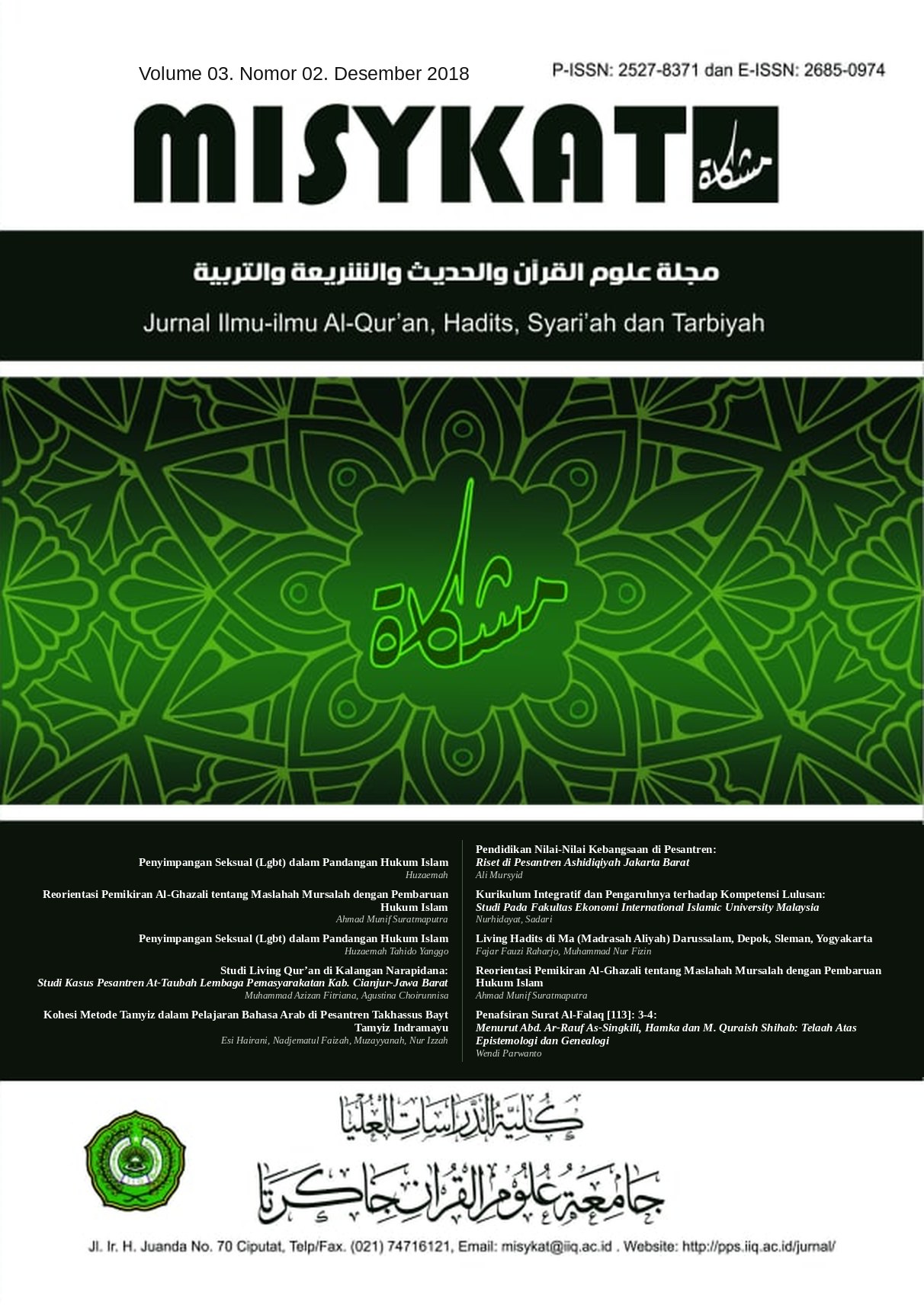
REORIENTASI PEMIKIRAN AL-GHAZALI TENTANG MASLAHAH MURSALAH DENGAN PEMBARUAN HUKUM ISLAM
Abstract
Revelation is divided into two categories: wahyu matluw, namely the Holy Qur'an, and wahyu ghayr matluw, namely the Sunnah and Hadith. The law of God, or Islamic law (ahkam shar'iyyah), must serve as the guideline and reference for realising the welfare (maslahah) of humankind. On this basis, experts in fiqh and usul al-fiqh agree that maslahah is the core objective of the Lawgiver and of Islamic law, giving rise to the well-known maxim among them: "wherever there is maslahah, there is the law of God." Recognising that not every problem of life has its ruling stated in the Qur'an and the Sunnah/Hadith, Islam lays down general principles and basic rules that the ahl al-dhikr (mujtahids) can use to develop Islamic law and resolve new problems through ijtihad. One of these general principles is that the principal aim of the Lawgiver and of Islamic law is to bring about benefit (jalb al-masalih). From this principle, the mujtahid imams and experts in usul al-fiqh developed Islamic law and sought to resolve new problems faced by Muslims for which there is no explicit ruling in the Qur'an and the Sunnah, through qiyas, istihsan, maslahah mursalah and sadd al-dhari'ah. Al-Ghazali (450-505 AH), an expert in usul al-fiqh from the Shafi'i school, offered interesting ideas on maslahah mursalah. His view represents a middle way between those who reject maslahah mursalah entirely as a source of law and those who rely on it too boldly.
References
Al-Amidi, al-Ihkam fi usul al-Ahkam, juz.4, Beirut: Dar al-Kutub al-„Ilmiyah, t.t.
Al-Asnawi, Nihayah al-Wusul, Beirut : Alam al-Kutub, 1982.
Al-Ghazali, al-Mustasfa min „Ilm usul, juz.2, t.tp.: Dar al-Fikr, t.t.
Al-Hammam, Al-Kamal ibn, at-Tahrir, Juz.4, t.tp : Dar al-Fikr, t.t.
Al-Hasyimi, Sayyid Ahmad, Muhtar al-Ahadis an-Nabawiyyah, cet. Ke-12, Beirut: Dar al-Fikr, t.t.
Al-Hudari, Usul al-Fiqh, cet. Ke-7, t.tp.: Dar al-Fikr, 1981.
Al-Kalbi, Taqrib al-Wusul ila „Ilm al-Ushul, Tahqiq Dr. AsySyanqiti, Cairo : Maktabah Ibn Taymiyah, 1414 H.
Al-Minawi, faid al-Qadir, juz.2, Cairo: Maktabah at-Tijariyah alKubra, 1938.
Al-Qardawi, Yusuf, al-Ijtihad al-Mu‟asir, t.tp. : Dar at-Tauzi‟ wa an-Nasyr al-Islamiyah, 1994.
Ar-Razi, Fakhr ad-Din, al-Mahsul fi „Ilm Usul al-Fiqh, cek ke-1, jilid.2, Beirut: Dar al-Kutub al-Ilmiyah, 1998.
As-Salih, Adib, Tafsir an-Nusus, juz.1, Beirut: Dar al-Jil, t.t.
As-San‟Ani, Subul as-Salam, t.tp : Dar al-Fikr, t.t.
Asy-Syafi‟i, ar-Risalah, cet. Ke-1, Kairo: Matba‟ah al-Halabi, t.t. Asy-Syaukani, Irsyad al-Fukhul, Surabaya: Salim bin Sa‟id, t.t.
Asy-Syirazi, al-Luma‟ fi Ushul al-Fiqh, Semarang :Toha Putra, t.t.
Badran, Badran Abu al-„Ain, Ushul al-Fiqh al-Islami,
Iskandariyah: Mu‟assasah Syabab al-Jami‟ah, t.t. Bukhari, Sahih al-Bukhari, juz.2, Beirut: Dar al-Fikr, t.t.
Dawud, Abu, Sunan Abi Dawud, juz.2, Beirut : Dar al-Fikr, t.t.
Depdikbud, Kamus Besar Bahasa Indonesia, cet. Ke-7, edisi ke2, Jakarta : Balai Pustaka, 1996.
Echols, John M. dan Hasan Shadly, Kamus Inggris Indonesia, Jakarta: PT Gramedia Pustaka Utama, 1978.
Fakhr ad-Din ar-Razi, al-Mahsul fi „Ilm Usul al-Fiqh, cek ke-1, juz.2 (Beirut: Dar al-Kutub al-Ilmiyah, 1998), 39.
Hanbal, Ibn, al-Musnad, juz.2, Beirut: al-Maktab al-Islami, 1978.
Hassan, Husain Hamid, Nazariyyat al-Maslahah fi al-Fiqh alIslami, t.tp : Dar al-Nahdah al-„Arabiyyah, 1971.
Khallaf, „Abd Wahhab, Masadir at-Tasyri al-Islami fima la Nassa fih, Kuwait: Dar al-Qalam, t.t.

This work is licensed under a Creative Commons Attribution-ShareAlike 4.0 International License.
Copyright Notice
Copyright and Licensing Terms of Jurnal MISYKAT
Authors who publish their work in Jurnal MISYKAT agree to the following terms:
-
Copyright Retention: Authors retain full copyright ownership of their articles without any restrictions.
-
Right of First Publication: Authors grant Jurnal MISYKAT the right of first publication, allowing the journal to publish and distribute the work simultaneously in both print and electronic formats.
-
Creative Commons Licensing: All articles published in Jurnal MISYKAT are licensed under a Creative Commons Attribution-ShareAlike 4.0 International License (CC BY-SA 4.0).
What does this mean for authors and readers? Under this license, anyone is free to:
Share: Copy and redistribute the material in any medium or format.
Adapt: Remix, transform, and build upon the material for any purpose, even commercially.
Under the following strict conditions:
Attribution: You must give appropriate credit, provide a link to the license, and indicate if changes were made. You may do so in any reasonable manner, but not in any way that suggests the licensor endorses you or your use.
ShareAlike: If you remix, transform, or build upon the material, you must distribute your contributions under the same license as the original.
-
Self-Archiving Policy: Authors are permitted and highly encouraged to post their work online (e.g., in institutional repositories, open-access repositories, or on their personal websites) after the official publication process is complete. This practice is encouraged as it can lead to productive academic exchanges, as well as earlier and greater citation of the published work.
Privacy Statement (Recommended addition for OJS)
The names and email addresses entered in this journal site will be used exclusively for the stated purposes of this journal and will not be made available for any other purpose or to any other party.